Hairline cracks in walls are almost always cosmetic. A true hairline crack is thinner than about 0.1 mm, around the thickness of a sheet of paper, and the standard UK building damage scale used by engineers puts it in the lowest category, needing no structural repair. Most come from framing lumber drying, seasonal moisture swings, or joint compound shrinking. A few are early signs of slab movement, and the pattern tells you which. This page covers how to measure one, what causes it, how to fix it so it stays hidden, and when a hairline crack is worth a look as part of foundation crack repair.
How thin is a hairline crack in a wall?
A hairline crack is one under about 0.1 mm wide, roughly 4 thousandths of an inch. You can see it as a thin dark line, but you cannot push a fingernail or the edge of a business card into it. BRE Digest 251, the damage scale engineers use for low-rise houses, calls these category 0 and says no repair action is needed. Anything you can slip a card into is wider than hairline.
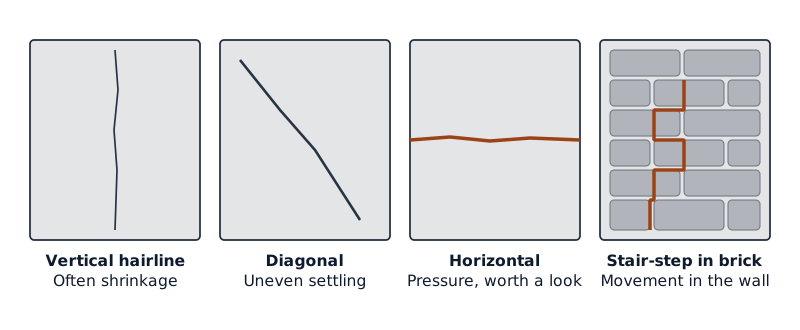
Where a hairline sits on the full scale:
| Category | Crack width | What it usually means |
|---|---|---|
| 0 | Under 0.1 mm | Hairline. Negligible, no repair needed |
| 1 | Up to 1 mm (about 1/25 inch) | Fine. Fixed with normal redecoration |
| 2 | Up to 5 mm (about 3/16 inch) | Easily filled. Doors may need adjusting |
| 3 | 5 to 15 mm | Needs opening up and repairing |
| 4 | 15 to 25 mm | Extensive damage, frames distort |
| 5 | Over 25 mm | Structural, major repair likely |
BRE adds that a crack getting wider over time can move up a category even while it still looks thin, so one measurement is never the whole answer. The full range of patterns, from hairlines to stair-steps, is set out in our guide to types of cracks in walls.
What causes hairline cracks in walls in Houston homes?
Most hairline cracks in walls start inside the wall, not under the house. Framing lumber keeps drying for months after a house is built and shrinks across its grain, so studs and joists get thinner and pull away from the back of the drywall. Joint compound shrinks as it cures. Houston's humid summers and air-conditioned interiors then move the wood a little every season, which reopens the same fine lines.
Building Science Corporation sums it up: wood moves and gypsum board does not, so the more wood a sheet is fixed to, the more it cracks. That is why hairlines gather in predictable spots:
- Tape joints, where two sheets of drywall meet and the compound is thinnest.
- Above door and window frames, where a deep header shrinks more than the studs beside it.
- Inside corners and stairwells, where several pieces of framing meet.
- Small round bumps or short lines over a fastener, often called nail pops, where the stud has dried and pulled back.
- Fine webs in old plaster, common in older pier-and-beam houses in neighborhoods like Houston Heights, where brittle plaster on wood lath flexes with the floor.
Can a hairline crack in a wall mean foundation problems?
Yes, but only some do. A single hairline at a drywall seam is rarely about the foundation. Hairline cracks become a warning when several appear at once on the same side of the house, run diagonally out from door and window corners, keep growing past a pencil mark, or turn up alongside sticking doors, sloping floors, or matching cracks in the exterior brick. That pattern suggests the slab under that wall is moving.
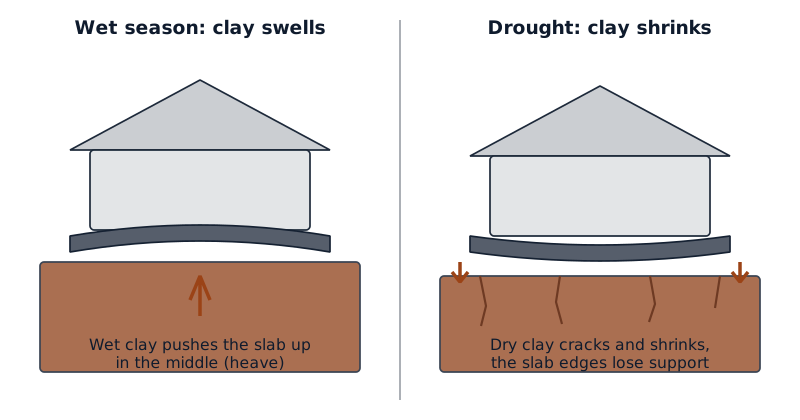
Houston's clay is the reason a small crack can matter here. The USDA describes Lake Charles clay, common across the area, as 45 to 60% clay that opens surface cracks 1/2 to 2 inches wide in dry spells. When the soil under one edge of a slab shrinks or swells more than the rest, the first sign indoors is often a set of fine diagonal lines. Doors that start to bind at the same time are a strong second clue; our page on doors sticking explains how to check them.
Horizontal cracks are a different case. Advice online about serious horizontal cracks usually describes a basement wall bowing under soil pressure, and Houston homes almost never have a basement. A horizontal hairline in a Houston interior wall is far more often a drywall seam or the line where the ceiling meets the wall.
Is it a crack in the wall or just cracked paint?
Look closely in raking light from a flashlight held flat to the wall. Cracked paint shows as many short, random lines in a crazed or scaly pattern, often over one area, and it sits only in the paint film. A crack in the wall itself is a single line, or a few, that follows a seam, a corner, or a straight path, and you can usually trace it through the paint into the compound or plaster below.
Paint cracking is a coating problem, usually fixed by scraping and repainting, not by filling. If the house was built before 1978, the US Environmental Protection Agency says it is more likely to contain lead-based paint and advises against dry sanding. Fix small damaged patches without sanding, or wet the surface first and keep the area small.
How do you fix hairline cracks in walls so they stay hidden?
Wait until the crack has stopped changing, then open it slightly, bed a strip of tape over it in joint compound, feather two thin coats wider than the crack, sand lightly, prime, and paint. Filling a hairline with a smear of compound alone usually fails, because the same small seasonal movement reopens it within a year. The tape is what bridges the movement.
Step by step:
- Mark it first. Pencil a short line across each end and write the date. Check after a few weeks and again after a change of season.
- Open the crack. Run a utility knife along it to make a shallow V so the compound has something to grip.
- Tape it. Press paper or mesh tape into a thin bed of compound centered on the crack.
- Feather two coats. Each coat a little wider than the last, so the patch disappears under paint.
- Sand, prime, paint. Prime the patch before the top coat or it will show as a dull spot.
For which compound, caulk or spackle suits each surface, see our guide to filler for cracks in walls. Plaster needs a different method, covered in cracks in plaster walls.
DIY stops at the wall surface. If the cracks are coming from a moving slab, patching hides a symptom, and any foundation repair in the City of Houston needs a building permit, which a foundation contractor pulls.
Can moisture cause hairline cracks in walls?
Yes. Moisture is one of the main drivers. Wood framing swells as it takes up moisture and shrinks as it dries, so humid summers, long dry spells and air conditioning all move the studs a little, and fine cracks open and close with the seasons. A hairline near a bathroom, window or exterior wall that also shows staining, bubbling paint or soft drywall points to a water leak instead.
Fine interior cracks rarely let water in. Outside, a hairline in exterior brick mortar or stucco can let rain into the wall over time, and sealing it is a small waterproofing job worth doing before it grows.
When should a hairline wall crack get a professional look?
Get a foundation contractor out when hairline cracks keep reappearing in the same places after a proper taped repair, when several show up together on one side of the house, when one grows past your pencil marks, or when they come with sticking doors, sloping floors, gaps at window frames or matching exterior cracks. A single stable hairline at a seam does not need one.
A foundation inspection is the usual next step. A local contractor checks the slab with a level, walks the outside for cracks and drainage problems, and tells you whether the movement is active. If repair is needed, you get the scope and price in writing before any work starts. For a calmer read on which cracks can wait, our guide to when to worry about cracks in walls sorts them by urgency.
Questions people ask
Are hairline cracks in new construction normal?
Yes, they are common in the first year or two. Framing lumber is still drying and shrinking after the house is finished, and the drywall fixed to it picks up fine lines at seams, corners and above doors. Check whether your builder's paperwork covers drywall touch-ups. If the cracks are diagonal and growing, mention it to the builder sooner.
Should I fill a hairline crack straight away?
Not straight away. Mark it and date it first, then watch it for a few weeks and through a change of season. If it stays the same, a taped repair and fresh paint will hide it for good. Filling it too early can hide the one clue that tells you whether the wall, or the slab beneath it, is still moving.
Why do hairline cracks come back after painting?
Paint and compound alone cannot stretch with the wall. The framing behind it shrinks and swells a little with every change in humidity, and that small movement reopens a crack that was only filled. Bridging it with tape bedded in joint compound, then feathering the patch wide, is what stops a hairline crack from showing through the new paint again.
What is the difference between a hairline crack and a structural crack?
Width and behavior. A hairline crack is under about 0.1 mm, stable, and confined to the wall finish. A structural crack is wider, often well past 5 mm, may have one side offset from the other, and usually grows over time. Engineers on the BRE damage scale treat the bottom three categories, up to about 5 mm, as cosmetic and the top ones as affecting how the building works.
This guide is one of many on the foundation repair guide for Houston.
Sources
- Designing Buildings, crack damage categories from BRE Digest 251
- BRE Group, assessing cracks in houses
- Building Science Corporation, RR-0107 Drywall, Wood and Truss Uplift
- USDA NRCS, Lake Charles soil series description
- US Environmental Protection Agency, protect your family from sources of lead
- City of Houston weekly building permit report, July 2024
Last changed