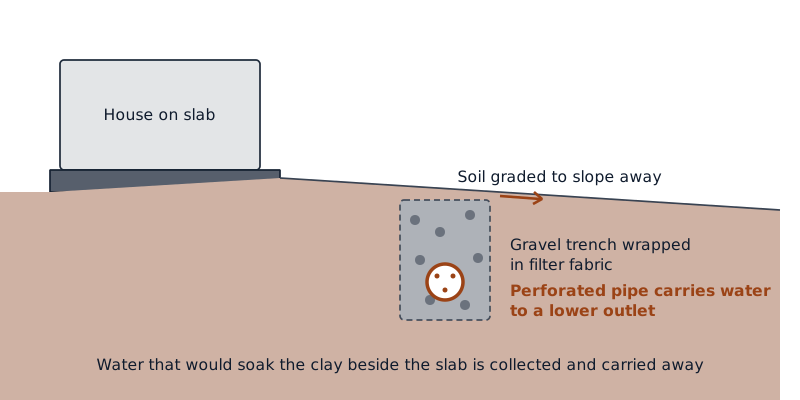
A foundation drain, also called a footing drain, is a perforated pipe laid beside the footing, below the slab or crawl space floor, to catch groundwater before it presses against the foundation. A French drain is a gravel trench, usually with a pipe, that collects water in the yard and carries it away. For most Houston homes the French drain, or plain surface foundation drainage, is the right tool: houses here are mostly slabs with no basement, and footing drains exist mainly to protect rooms below ground. This page compares the two side by side, then covers costs, older houses and footing types.
What is the difference between a foundation drain and a French drain?
The difference is depth and job. A foundation drain sits down at the footing, outside it and below the floor level, and guards the foundation wall from groundwater. A French drain sits higher, often in the yard or along a bed, and intercepts water moving through the topsoil or across the surface. Both use gravel, fabric and perforated pipe, and both need an outlet lower than the pipe.
| Foundation (footing) drain | French drain | |
|---|---|---|
| Where it sits | Beside the footing, below the slab or crawl space floor | In the yard, along beds, or partway along the house |
| What it catches | Groundwater pressing on the foundation wall | Surface runoff and shallow water in the topsoil |
| Usual trench | At least 16 inches wide and 16 inches deep for a 4-inch pipe | Shallow to moderate; the site decides the depth |
| Best fit | Basements and below-grade rooms | Slab-on-grade and pier-and-beam homes with pooling water |
| Best time to install | When the house is built | Any time, as a retrofit |
| How common in Houston | Rare, as basements are rare | Common |
The federal Building America guide puts the footing drain pipe outside the footing, not on top of it, bedded in washed gravel and fabric. Its water goes to daylight at least 10 feet from the house, a dry well, a sump, or a storm sewer the city approves.
Does a Houston house need a footing drain?
Usually not. Section R405.1 of the residential code used in Texas requires drains around concrete or masonry foundations that hold back earth and enclose habitable or usable space below grade. A typical Houston slab encloses nothing below grade, so the rule doesn't reach it. The same section waives drains on well-drained sandy or gravelly soil, which Houston clay is not.
What a Houston slab needs instead is evenly moist soil around its edge beam. The USDA describes Lake Charles clay, common here, as 45 to 60% clay with very slow permeability once wet. A pipe at footing depth in that soil collects little.
So the work that pays off here sits near the surface:
- Ground that falls at least 6 inches within the first 10 feet from the house, as section R401.3 of the code asks.
- Paved surfaces within 10 feet of the house sloped away from it.
- Gutters with downspouts carried well clear of the slab.
- A French drain or swale where water still collects after that.
You'll find the surface fixes laid out on drainage around a house foundation.
What is better than a French drain?
Often something simpler. If water reaches your slab because the yard slopes toward it, regrading beats any buried pipe. If it comes off the roof, gutters and downspout extensions fix it for far less. A shallow swale moves surface water without clogging. A French drain is better where water soaks in and lingers, and a footing drain only where a room sits below ground.
Watch a heavy rain, note where water pools, and fix downspouts and grade first. Then check for an outlet: flat Houston lots often have no lower spot, and without one a drain needs a pump or a city-approved storm sewer connection.
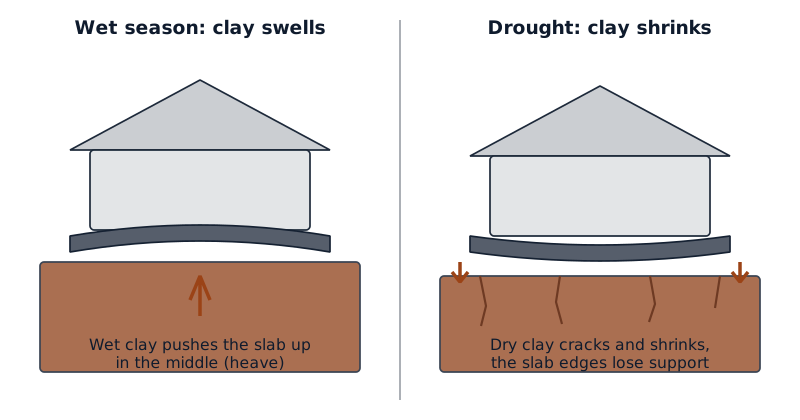
The clay cuts both ways. Draining one side hard while the other stays wet can leave the slab unevenly supported, so some homeowners keep the soil steady in drought with soaker hoses for a foundation.
How much does each type of drain cost?
A French drain costs about $5,000 on average nationally, with most jobs between $1,650 and $12,250, according to an October 2026 cost guide. Exterior French drains run about $10 to $65 per linear foot. Interior drains, cut through a floor, run about $40 to $100 per linear foot. We haven't found a published price for footing drains alone on existing Houston homes.
| Drain work | Typical range | Source |
|---|---|---|
| French drain, typical job | $1,650 to $12,250 | National cost guide, 2026 |
| French drain, average job | $5,000 | National cost guide, 2026 |
| Exterior French drain, per linear foot | $10 to $65 | National cost guide, 2026 |
| Interior drain, per linear foot | $40 to $100 | National cost guide, 2026 |
| Foundation inspection in Houston | $300 to $1,000 | Houston Press guide, 2026 |
A retrofit footing drain means digging to the footing along every wall, so expect the top of these ranges or above. Trench length and depth, distance to an outlet, a pump, and concrete in the way set your price. See foundation drainage systems cost.
What about an old house foundation without footings?
Some older Houston houses have no continuous footing for a drain to sit beside. Many early pier-and-beam homes, such as the Craftsman bungalows of the Houston Heights built around 1905 to 1925, rest on individual piers with wood beams over a crawl space. On those houses a footing drain has nothing to protect, so drainage work aims at keeping the crawl space dry.
Today's code asks for continuous footings under exterior walls (section R403.1), but that governs new work, and an older house built differently is not automatically unsafe. Grade the soil away, keep skirting from trapping water, and send downspouts clear of the crawl space.
If floors already slope or doors bind, drainage won't fix that. See pier and beam foundation repair for resetting and shimming piers.
What are the five types of footings?
Five common types of footings for buildings are wall (strip) footings, isolated footings, combined footings, strap footings and mat (raft) foundations. Wall footings run under load-bearing walls. Isolated footings carry a single column. Combined footings share two or more columns. Strap footings link separate pads with a beam. A mat is one continuous slab under the whole building.
Most Houston homes built since the 1960s use another form, the slab on grade, where the slab and its thickened edge beams act as the footing. There's no basement wall to keep dry, only soil under the edge beam to keep steady.
When should a professional look at your drainage?
Call for a visit when water stands against the slab a day after rain, when the drain you have backs up, or when you see signs the house is moving: cracks through brick or drywall, sloping floors, sticking doors. At that point the question is no longer only drainage. A foundation inspection tells you whether water is the whole problem.
If the slab has already dropped, a drain stops further damage but won't lift it, and slab foundation repair comes into it. If drainage is the whole job, we'll arrange a visit from a local contractor who installs drainage systems, and you get a written price before any digging starts. Ask for a drainage quote.
Questions people ask
Is a footing drain the same as a French drain?
Not quite. Both use gravel, filter fabric and perforated pipe, and some people use the names loosely. A footing drain sits at the bottom of the foundation, beside the footing, to relieve groundwater pressure on a below-grade wall. A French drain usually sits higher in the yard and catches water moving through the topsoil. On a typical Houston slab, the French drain is the one you're likely to need.
Can I install a French drain myself?
You can install a short yard French drain yourself if the ground falls to a usable outlet. Texas law says to call 811, free, at least two days before digging deeper than 16 inches. Line the trench with fabric, bed the pipe in washed gravel with perforations down, keep a steady fall, and wrap the fabric over the top. Leave footing-depth trenches, runs right against the slab, and anything that needs a pump to a contractor. The steps are in how to install foundation drainage.
How long does a French drain last?
A well-built French drain typically lasts 30 to 40 years, according to the October 2026 cost guide. Silt is the usual cause of an early failure, so clean washed gravel and a full fabric wrap matter in Houston clay. Keep the outlet clear and don't drive heavy equipment over the trench, which can crush the pipe.
Do I need to be home while the drain goes in?
Usually only at the start and the end. The contractor needs to confirm the route, the outlet and any buried lines with you before digging, and you'll want to check the finished grade and outlet afterward. If the job involves a sump pump or a connection inside the house, plan to be there for that part.
See the foundation repair guide for Houston for the other services and what they cost.
Sources
- PNNL Building America Solution Center, footing drain pipe
- 2021 International Residential Code as adopted in Texas, Chapter 4 (R401.3, R403.1, R405.1)
- LawnStarter, French drain cost guide (October 2026)
- USDA NRCS, Lake Charles soil series description
- Houston Press, guide to foundation repair in Houston (2026)
- Railroad Commission of Texas, know before you dig
- Houston Heights design guidelines, City of Houston Planning
Last changed