A foundation drainage pipe is a perforated pipe laid in gravel along the outside of a foundation, so groundwater runs away from the house instead of soaking the soil beside it. On a Houston slab, though, water inside the house or a soggy patch against the beam is often not a drainage problem at all. It can be a slab leak: a supply or drain line cracked under the concrete. The two need very different fixes. This page explains how a drain pipe works, the signs of a slab leak, how slab leak detection is done, and what each job costs here.
What does a foundation drainage pipe do on a Houston slab?
A foundation drainage pipe collects water from the soil next to the foundation and carries it to a lower outlet, such as the street, a dry well or a pump. In Houston, where most homes sit on a slab with no basement, its job is to keep the clay at the edge of the slab from swinging between soaked and dry, which moves the beam up and down.
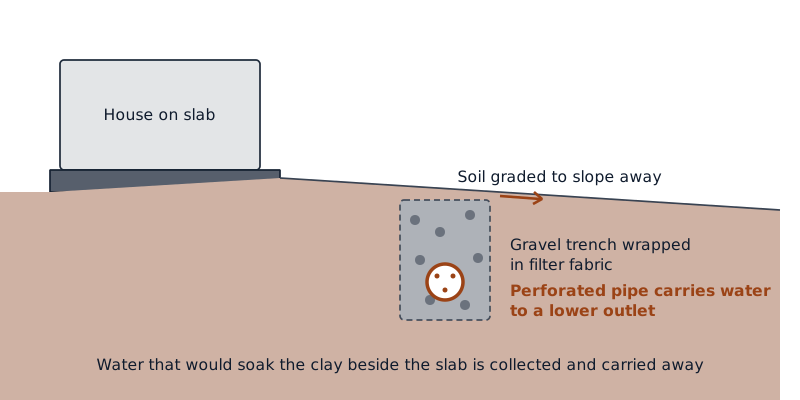
The USDA describes the Lake Charles clay found across much of the area as 45 to 60% clay. In dry spells it cracks up to two inches wide and a foot or more deep, and rain pours straight in. A perimeter drain, also called exterior foundation drainage or a footing drain, keeps that water from ponding against the beam.
Drainage boards and dimpled drainage mats are for basement walls, which Houston homes rarely have. For grading, French drains and other options, see foundation drainage solutions for Houston clay.
How do I know if I have a slab leak?
The first signs of a slab leak are usually a water bill that climbs for no reason, the sound of running water when every fixture is off, or a warm or damp spot on the floor. Later come warped flooring, mold smells, new cracks and moisture along the outside of the slab. A simple meter test tells you quickly whether water is escaping somewhere.
The EPA's test is easy: read your water meter, use no water for two hours, then read it again. If it moved, you probably have a leak. Then narrow it down:
- Hot water line. A warm patch on tile or concrete, or a water heater that runs constantly, points to the hot side.
- Supply line. The meter spins with everything off, and pressure may drop.
- Drain line. The meter doesn't move, but you notice sewer smells, slow drains or damp soil near a cleanout.
Each sign is covered in slab leak symptoms.
How common are slab leaks in Houston homes?
No public agency tracks slab leaks, so there is no reliable count. What is known is that leaks of every kind are common: the EPA says the average household's leaks waste more than 9,300 gallons a year, and nine percent of homes have leaks wasting 50 gallons or more a day. Houston's slab-on-grade homes put many of those lines under concrete.
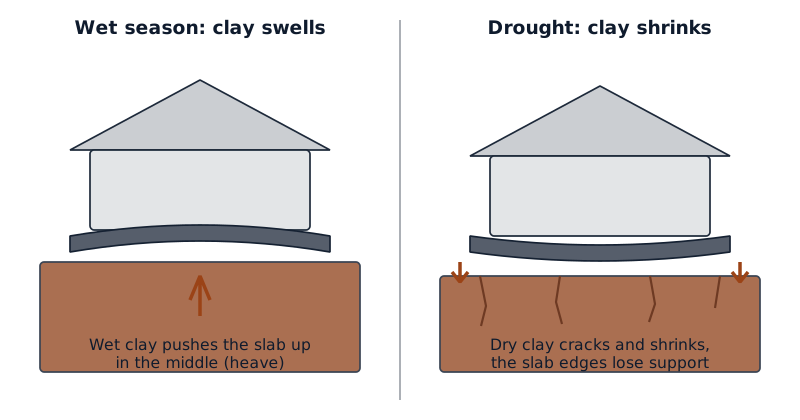
Houston's soil adds stress. When expansive clay shrinks and swells, the slab flexes slightly, and pipes under it flex too. Older copper and cast iron lines can wear through where they rub against concrete or gravel.
A slab leak can also cause foundation damage: water softens the clay under one part of the slab, which can heave or sink while the rest stays put. If fresh cracks appear near a wet area, have the plumbing checked before anyone quotes slab foundation repair, or the movement can start again.
How do plumbers find a leak under a slab?
Professional slab leak detection starts with isolating each line: the plumber shuts off sections and pressure tests them to learn whether the hot, cold or drain side is losing water. Then they use acoustic listening gear, which picks up the hiss of water escaping under concrete, and often thermal imaging for hot lines, to mark the spot before anything is cut.
Drain lines are checked with a camera through a cleanout, or by plugging and filling the drain to see if the level drops. You'll see underground water leak detector tools for rental, but reading sound through concrete takes practice, and a wrong mark means cutting in the wrong place. I think the plumber's detection fee is usually money well spent.
Can a drain pipe go straight into the ground?
A foundation drain pipe can end in the ground only where the soil drains freely, such as into a dry well in sandy ground. On most Houston clay that fails, because the water has nowhere to go and backs up. A Houston foundation drain normally needs a daylight outlet at a lower point, a connection to the street drainage where allowed, or a sump pump.
The same goes for downspouts piped into a buried line that just stops: that puts more water by the foundation, not less. Checking there's enough fall to reach the outlet is covered in how to install a foundation drainage pipe.
Should you put gravel under a drainage pipe?
Yes. The drainage code used in Texas, the International Residential Code, says perforated pipe must sit on at least 2 inches of washed gravel or crushed rock, with at least 6 inches of the same material over it. The gravel keeps the holes clear and lets water reach the pipe from every side, and a filter fabric wrapped around it stops clay silt clogging the stone.
The gravel bed should also reach at least 1 foot beyond the outside edge of the footing and 6 inches above its top. On Houston clay the geotextile fabric matters, because fine clay washes into bare gravel and clogs it.
How deep should a 4 inch drain pipe be buried?
For a foundation drain, depth follows the footing, not a fixed number: the pipe sits beside or just below the bottom of the footing or grade beam, on its gravel bed. Under a Houston slab that is often shallow, because the beams themselves are shallow. What matters most is a steady fall along the whole run toward the outlet.
A yard drain is usually set only as deep as that fall needs. Pair it with grading: the code asks for the ground to fall at least 6 inches in the first 10 feet from the house.
During Hurricane Harvey, the Harris County Flood Control District measured 47.4 inches of rain in four days at Clear Creek and I-45, near Clear Lake. No foundation drain is sized for that.
How much does it cost to fix a leak under a concrete slab?
This Old House puts the national average slab leak repair at about $2,300, with most jobs between $630 and $4,400 or more. Finding the leak is extra: slab leak detection runs $150 to $600. The repair method drives the bill, and rerouting lines around the slab can reach $15,000 in a large house.
| Work | Typical cost range |
|---|---|
| Slab leak detection | $150 to $600 |
| Broken pipe repair | $200 to $2,000 |
| Waterline repair | $300 to $1,400 |
| Under-slab plumbing (opening or tunneling) | $500 to $4,000 |
| Rerouting plumbing | $1,500 to $15,000 |
| Foundation repair after water damage | $2,000 to $7,500 |
These are national figures, not quotes. A plumber may cut through the floor over the leak, tunnel in from outside, or abandon the old line and run a new one overhead. See also concrete slab leak repair cost and foundation leak repair cost.
If the leak has already moved the slab, we'll arrange a visit from a local foundation contractor once the plumbing is fixed, with a written foundation quote before any work starts. More on Houston foundation repair.
Questions people ask
Does home insurance cover leak detection?
Sometimes. The Texas Department of Insurance lists sudden and accidental release of water as a covered risk in most policies, but a continuous leak is not covered. Many insurers pay to find and reach a sudden leak and repair the water damage, while the pipe itself is your cost. Damage to foundations or slabs is often an optional endorsement. Read your declarations page, and see whether homeowners insurance covers slab leak repair.
How much does it cost to fix a leak under the floor?
It depends on how the plumber reaches the pipe. A short broken section reached through one hole in a slab floor can cost $200 to $2,000, according to This Old House. Tunneling or opening a larger section to reach under-slab plumbing runs $500 to $4,000. On a pier-and-beam house, the pipes are in the crawl space, so access is far easier and usually cheaper.
How much does it cost to reroute plumbing lines in slab foundation?
This Old House puts rerouting at $1,500 to $15,000. The low end is a single line run through a wall or attic to bypass a short leaking section. The high end is repiping several fixtures or a whole house. Rerouting often makes sense on older copper or cast iron lines, where a spot repair may just move the next leak a few feet along.
Does a Houston slab house need a foundation drain by code?
Usually not. The residential code requires foundation drains around concrete or masonry foundations that retain earth and enclose habitable or usable space below grade, which describes a basement. A typical Houston slab on grade has no such space. Code still asks for the ground to slope away from the house, and a drain pipe is often added where grading alone can't move the water.
Read on
- Costs
What a leak under a Houston slab costs to find and fix in 2026: detection, spot repairs, tunneling, rerouting, and the foundation work a…
- Slab leak symptoms
The signs of a leak under a Houston slab, a two-hour meter test you can do today, how to tell hot, cold and drain lines apart, and when to…
Sources
- 2021 International Residential Code as adopted in Texas, Chapter 4 (R401.3 and R405.1)
- US EPA WaterSense, Fix a Leak Week
- Texas Department of Insurance, homeowners insurance guide
- This Old House, slab leak repair cost guide (April 2026)
- USDA NRCS, Lake Charles soil series description
- Harris County Flood Control District, Hurricane Harvey immediate flood report
Last changed