Sugar Land homes move for two reasons you can measure. The Fort Bend Subsidence District's GPS station P004 in Sugar Land has recorded about 30.9 cm, roughly a foot, of sinking since 1994, though the pace has slowed to 0.61 cm a year. And the Lake Charles clay, a soil first described from a site in Fort Bend County, shrinks and cracks in dry spells. This page covers what those two facts mean for a slab here, the City of Sugar Land's permit and floodplain rules, and local prices. For other parts of the metro, see the Houston areas page.
How much has the ground under Sugar Land sunk?
About 30.9 cm since 1994 at station P004, according to the Fort Bend Subsidence District's 2024 annual report. The 2020 to 2024 average was only 0.61 cm a year. Regional sinking like this lowers a wide area together, so its main effect on a single lot is usually on how water drains past it.
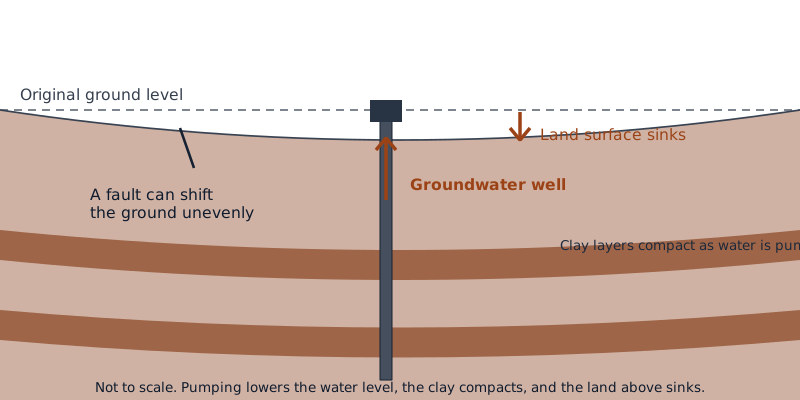
The district's own figures show how uneven Fort Bend is. Station P111 in Katy averaged 3.31 cm a year over the same period, more than five times the Sugar Land rate. Station P010 in Rosenberg has moved only about 8.1 cm since 1999, at 0.09 cm a year.
What does Fort Bend clay do to a Sugar Land slab?
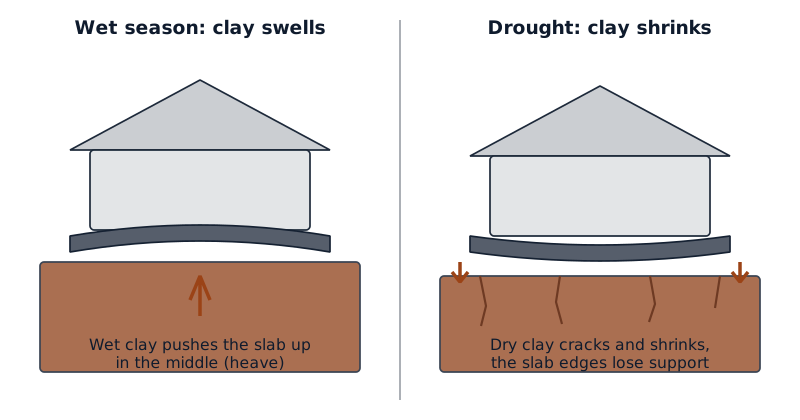
The Lake Charles series, which the USDA typed in Fort Bend County, is 45 to 60% clay. When it dries, it splits into cracks half an inch to two inches wide and a foot or more deep, and in most years those cracks stay open for 60 to 90 days. A slab sitting on that ground rises and drops a little with every wet and dry cycle.
The first heavy rain after a drought matters most. Water pours into the open cracks, then barely moves once the clay swells shut. One side of a house can end up wetter and higher than the other. Uneven movement like that is a common cause of diagonal drywall cracks and sticking doors, and it's why a local contractor often looks at foundation settling and soil moisture before recommending slab foundation repair.
Does Sugar Land require a permit for foundation work?
The City of Sugar Land's permit FAQ says no one may alter, repair or replace a structure without first obtaining a permit. The FAQ doesn't name foundation work separately, so ask the contractor quoting your job to confirm with the city that a building permit is needed and who will apply for it. Every application now goes through the city's online Citizen Self Service portal.
A few details from the city's own pages:
- The portal has a Fee Estimator, which is the place to check the permit fee for your job rather than relying on a national average.
- The city adopted the 2021 International Building Code family in 2023.
- If your lot is in the floodplain, the city requires a floodplain development permit, approved by its Engineering Department and filed with the building permit application.
Can a foundation repair count as a substantial improvement in Sugar Land?
It can, if it pushes your total repair and remodel spending past the city's line. Sugar Land counts work as a substantial improvement when it reaches 50% or more of the building's current market value, and it adds up all such work over the past five years. Only the house's value counts, not the land. Crossing that line usually means the house must be raised to today's elevation rules.
A typical foundation repair, $3,300 to $6,800 for most Houston-area jobs in the Houston Press 2026 guide, sits well below that line. The risk comes when a pier job follows a kitchen remodel or flood repairs in the same five years. Crossing the threshold also ends any grandfathered flood insurance rating, and the city then requires an updated elevation certificate.
The required floor height depends on where you live. Outside a levee improvement district, the floor must clear the Atlas 14 100-year flood elevation by 2 feet, among other tests. Inside one, the 2 feet is measured from that district's ponding elevation.
How do heavier storms change drainage around Sugar Land homes?
Sugar Land adopted the Atlas 14 rainfall estimates on April 2, 2019. Under them, a storm that drops 12.5 inches in 24 hours went from a 1% chance in any year to a 4% chance. More water standing near a slab means more swelling in the clay on that side, so grading, gutters and downspouts deserve a look alongside any repair.
The city redrew its ponding maps in fall 2020 and warns that areas behind levees may see more street ponding. If water sits along your foundation after storms, ask for a foundation drainage assessment along with the repair quote, and see foundation repair cost for what each fix usually runs.
Questions people ask
How much does foundation repair cost in Sugar Land?
Most Houston-area foundation repairs cost $3,300 to $6,800, according to the Houston Press 2026 guide, with pressed concrete piers at $300 to $600 each and steel piers from about $1,000. Sugar Land adds its own permit fee, which you can price with the Fee Estimator on the city's Citizen Self Service portal. A written quote after a visit is the only reliable number for your house.
Is subsidence still a problem in Sugar Land?
It's slow now. Station P004 averaged 0.61 cm a year from 2020 to 2024, out of about 30.9 cm since 1994. At that pace, seasonal clay movement is usually the more likely cause of a new crack. Subsidence still matters for drainage, because ground that sinks unevenly can change where rainwater collects around your slab.
How do I know if my Sugar Land home is in a levee improvement district?
The City of Sugar Land publishes floodplain maps on its flood pages, and its floor elevation rules treat homes inside levee improvement districts differently. Before a large repair or a house raise, check those maps or ask the city's Engineering Department.
Should I get an inspection before buying an older Sugar Land house?
Yes, if you see cracks, sloping floors or doors that stick. The clay here moves with the seasons, so a crack that looks closed in a wet month may open in a dry one. A foundation inspection costs about $300 to $1,000 in the Houston area according to the Houston Press guide, and it tells you whether the slab has moved and by how much.
For the bigger picture, start from foundation repair in Houston.
Sources
- Fort Bend Subsidence District, 2024 annual groundwater report (stations P004, P111 and P010)
- USDA NRCS, Lake Charles soil series description
- City of Sugar Land, building permit FAQs
- City of Sugar Land, Section 7 building permits (2026)
- City of Sugar Land, floodplain forms
- City of Sugar Land, substantial improvement
- City of Sugar Land, minimum finished floor elevations
- City of Sugar Land, flood protection and Atlas 14
- Houston Press, guide to foundation repair in Houston (2026)
- This Old House, foundation repair cost guide (October 2026)
Last changed