Foundation problems across greater Houston come from the same few causes, but each area gets a different mix of them. Some suburbs are still sinking as groundwater is pumped out. Others took the worst of Hurricane Harvey. Inner neighborhoods have a century of pier-and-beam houses, and several areas sit in their own city with their own permit desk. Below, the 14 areas with their own pages are sorted into those groups, so you can see what matters on your street. It sits under our main Houston foundation repair service page, and the service reaches the rest of the Houston area too.
How foundation repair differs across Houston
Foundation repair differs across Houston because the ground, the flood history, the age of the houses and the permit rules change from one area to the next. Western and northern suburbs face ongoing land subsidence, bayou neighborhoods carry flood damage, the inner city has older pier-and-beam homes, and separate cities such as Bellaire set their own permit fees. The repair methods stay the same; the reasons behind them don't.
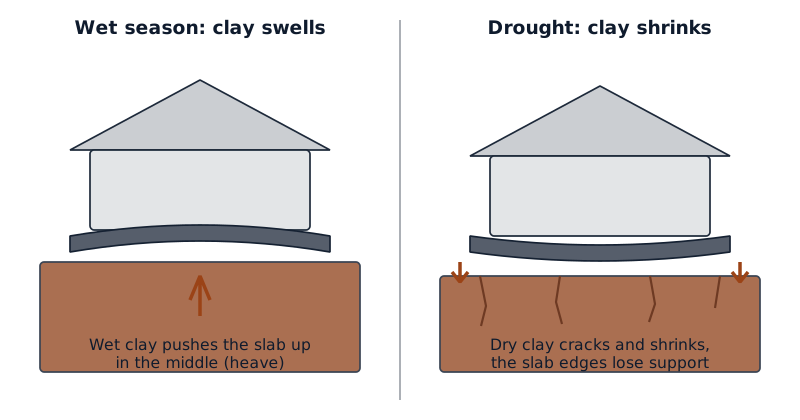
Under most of it lies heavy clay. The USDA's Lake Charles series, typed in Fort Bend County, is 45 to 60% clay and opens cracks up to 2 inches wide in dry weather, then swells shut when it rains. That shrink and swell is why so many slabs need foundation leveling at some point.
Which Houston areas are still sinking?
The fastest sinking today is in the west. The Harris-Galveston Subsidence District's 2025 report puts the highest measured rate, over 3 cm a year, in the Katy and Fulshear area. North of the city, the USGS records feet of past subsidence around Spring and The Woodlands. The east side sank most in the last century but has largely stopped since it moved to surface water.
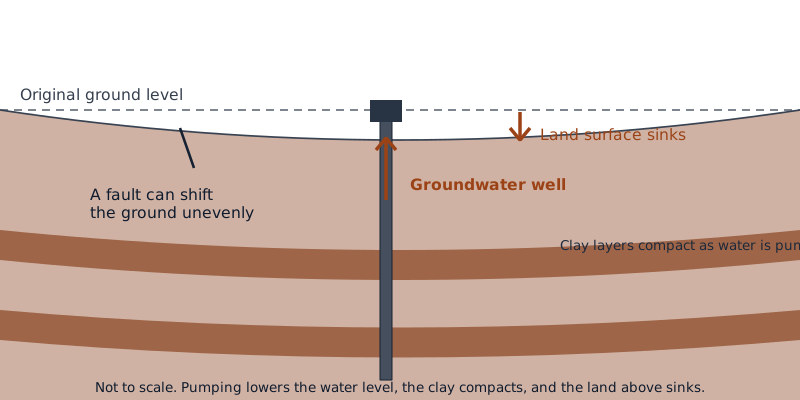
- Katy: a Fort Bend Subsidence District station there dropped about 10.7 cm since 2021, and the soil is a loamy series rather than coastal clay, so regional sinking drives more of the movement than shrink and swell.
- Sugar Land: about 30.9 cm of total sinking at one station since 1994, now slowed to well under a centimeter a year, on the Lake Charles clay named for this county.
- Jersey Village: 1996 satellite data from the USGS showed a subsidence bowl near here of almost 270 square miles.
- Spring: roughly 4.2 feet of subsidence through 2021, most of it after 1987.
- The Woodlands: in Montgomery County, outside the Harris-Galveston district, with aquifer levels down more than 400 feet and a University of Houston study warning that local faults may move again.
- Pasadena: more than 10 feet of sinking between 1906 and 1995, mostly halted since the late 1970s.
- Baytown: up to 9 feet of sinking over the same span, and the USGS notes a house damaged by fault creep.
On the older east side, a crack is more likely from clay or an old fault than from fresh sinking. Out west, foundation settling can still be underway.
Which areas flooded worst in Harvey?
Harvey hit hardest along Cypress Creek, Brays Bayou, the San Jacinto River and Clear Creek. Floodwater soaks the clay under a slab, washes out fill and can leave a house sitting lower on one side once the ground dries. If your home flooded in 2017, ask the contractor to check grading and drainage as well as the slab itself.
- Meyerland: Brays Bayou above the 610 Loop ran 1 to 2 feet higher than the 1983, 2015 and 2016 floods.
- Cypress: middle and lower Cypress Creek reached its highest levels on record, past the 500-year mark in places.
- Kingwood: the West Fork of the San Jacinto rose 3 to 4 feet above the 1994 flood as Lake Houston hit a record pool.
- Clear Lake: 47.4 inches of rain fell in four days at Clear Creek and I-45, the most in Harris County, though subsidence there is now largely stable.
- Friendswood: flooding along Clear Creek and Cowart Creek was the worst on record, and FEMA paid to buy out 26 flood-prone homes.
In these areas, foundation drainage is often half the fix.
Where are the older pier-and-beam houses?
The Houston Heights is the clearest example. City design guidelines describe most of its houses as wood siding on pier-and-beam foundations, with Craftsman bungalows built mainly between 1905 and 1925. These homes sag at the beams and shift at the piers rather than cracking like a slab, and the work is usually shimming, resetting or replacing piers in the crawl space.
The Heights also has three historic districts where work needs a Certificate of Appropriateness. Pier and beam foundation repair explains the work on these older houses in more detail.
Which areas need a permit from their own city?
Inside the City of Houston, which includes the Heights, Meyerland, Kingwood and Clear Lake, foundation repair is permitted work: the city's weekly reports list foundation repair building permits. Bellaire, Katy, Sugar Land, Jersey Village, Pasadena, Baytown and Friendswood are separate cities with their own building departments and their own rules.
Bellaire publishes its rules plainly. It requires a permit before work begins, and its FY2026 fee schedule charges a flat $130 floodplain development permit for residential foundation work, doubled if work starts without one. For the other cities, check with that city's building department, or ask the contractor to confirm who pulls the permit.
Prices across Houston
Prices depend far more on the job than on the zip code. A Houston guide puts most local jobs between $3,300 and $6,800, with pressed concrete piers at $300 to $600 each and steel piers from about $1,000. What changes by area is the kind of work: more piers on sinking ground, more drainage in flood areas, more crawl-space work on older homes.
| Work | Typical range | Source |
|---|---|---|
| Most Houston foundation repairs | $3,300 to $6,800 | Houston Press |
| Pressed concrete pier, each | $300 to $600 | Houston Press |
| Steel pier, each | from about $1,000 | Houston Press |
| Foundation inspection | $300 to $1,000 | Houston Press |
| Crack filling | $250 to $800 | This Old House |
| Mudjacking or slabjacking | $550 to $1,300 | This Old House |
| Structural engineer report | $500 to $1,000 | This Old House |
| Permit | $75 to $150 nationally; $130 in Bellaire | This Old House; City of Bellaire |
These are guides. The written quote after a visit is the real price, and the foundation repair cost page breaks the numbers down further.
Questions people ask
Do prices change between areas of Houston?
Usually not much for the same job, since the same methods and materials are used across the metro. The total changes with what the house needs: a Katy slab on sinking ground may need more piers, a Meyerland home may need drainage work, and a Heights bungalow needs crawl-space access. Separate cities can add their own permit fee, such as Bellaire's $130.
Do you cover areas that aren't listed here?
Yes. The 14 area pages cover the places where the ground or the rules differ most, but the service runs across the wider Houston area, including the suburbs between them. Send your address through the quote form and we'll arrange a visit from a local foundation contractor who works your part of town.
Does a house that flooded in Harvey need a foundation inspection?
It is worth one if you see new cracks, sticking doors or sloping floors since the flood. Water under a slab can soften the clay and wash out fill, and the effects can show up years later. A foundation inspection costs a few hundred dollars and tells you whether the slab has moved or the damage is cosmetic.
Read on
- Baytown
Foundation repair in Baytown, TX: what nine feet of past subsidence, fault creep and the Brownwood story mean for your house, plus the…
- Bellaire
Foundation repair in Bellaire, TX: the city's own $130 floodplain permit, contractor rules, flood zones and protected trees, plus how to…
- Clear Lake
Foundation repair in Clear Lake, Houston: what Harvey's record rain on Clear Creek, slab homes from the 1960s on and the city permit mean…
- Cypress
Foundation repair in Cypress, TX: what record Cypress Creek flooding means for slabs, when Harris County needs a floodplain permit, and…
- Friendswood
Foundation repair in Friendswood, TX: what Harvey's record Clear Creek flooding means for your slab, the city's online permits, and how a…
- Houston Heights
Foundation repair for Houston Heights homes: old pier-and-beam bungalows, when the historic district office gets involved, White Oak Bayou…
- Jersey Village
Foundation repair in Jersey Village, TX: the city permit, what the White Oak Bayou flood record and the 1996 subsidence bowl mean for your…
- Katy
Foundation repair in Katy, where the region's fastest land sinking is measured: what subsidence, faults and loamy Lissie soil mean for…
- Kingwood
Foundation repair in Kingwood, TX: what Harvey's record San Jacinto flooding, pre-1985 drainage and the 1996 annexation mean for your…
- Meyerland
Foundation repair in Meyerland, Houston: what Harvey and the Brays Bayou floods mean for your slab or piers, the city permit, the 50%…
- Pasadena
Foundation repair in Pasadena, TX: what 10 feet of past subsidence, old fault scarps and Harvey's Vince Bayou flooding mean for your slab,…
- Spring
Foundation repair in Spring, Texas: about 4.2 ft of land subsidence, Spring Creek's Harvey flooding, Harris County permit rules and what a…
- Sugar Land
Foundation repair in Sugar Land, TX: how far the ground has sunk at station P004, what Fort Bend clay does to slabs, city permit and…
- The Woodlands
Foundation repair in The Woodlands: how a 400 ft aquifer drop, 2.5 ft of sinking and possible faults affect your slab, Township approval…
Sources
- USGS Fact Sheet 110-02, land subsidence in the Houston-Galveston region
- USGS Circular 1182, Houston-Galveston chapter
- USGS, report on groundwater and subsidence in the Houston area (2021)
- Harris-Galveston Subsidence District, 2025 annual groundwater report summary
- Fort Bend Subsidence District, 2024 annual groundwater report
- University of Houston, study on Houston subsidence and faults (2022)
- Harris County Flood Control District, Hurricane Harvey flood report
- FEMA, Friendswood acquisition project (2020)
- USDA NRCS, Lake Charles soil series description
- USDA NRCS, Katy soil series description
- Houston Heights design guidelines, City of Houston Planning
- City of Houston weekly building permit report, July 2024
- City of Bellaire, development services FAQs
- City of Bellaire, FY2026 master fee schedule
- Houston Press, guide to foundation repair in Houston (2026)
- This Old House, foundation repair cost guide (October 2026)
Last changed