Most cracks in brick walls on Houston homes are one of two things. A fine crack that stays in the mortar, often near a corner or a window, usually comes from the brick itself expanding and is fixed by repointing the joint. A crack that steps up through the mortar, tapers, or runs through the bricks themselves usually means the slab under that wall has moved. Fixing the brick alone won't hold then. This guide covers how to tell the two apart and how each brick repair is done. For cracks in the slab itself, start with foundation crack repair in Houston.
What causes cracks in brick walls on Houston homes?
Cracks in brick walls come from movement the wall can't absorb. Fired brick slowly grows as it takes on moisture, and the Brick Industry Association calls that expansion irreversible. Where a wall has too few expansion joints, it cracks at corners and beside windows. The other common cause is the foundation: when part of the slab settles or heaves, the brick above it cracks in a diagonal or stepped line.
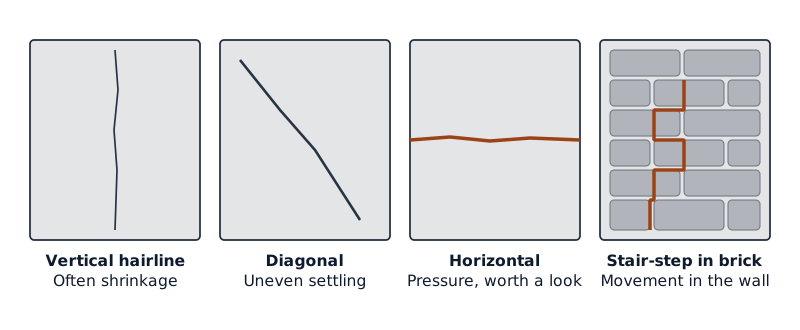
Most brick on Houston houses is veneer: a layer typically 3 or 4 inches thick, tied to the wood frame and resting on the slab edge, so it often shows slab movement first.
The causes in plain terms:
- Brick expansion. Cracks at a corner, usually at the first head joint on one side, or a vertical crack in a long wall with no soft joint.
- Brick bonded to concrete. The brick grows while the slab concrete shrinks, so the base course can crack or slide past the slab corner.
- Sagging lintels. The steel angle over a window or garage door bends, and the crack is widest at the steel and tapers to nothing.
- Foundation movement. Diagonal or stair-step cracks over one part of the slab. Clay soil is a common driver here: the USDA describes Lake Charles clay, found across southeast Texas, as 45 to 60% clay.
Which cracks in brick walls are serious?
The Brick Industry Association treats these as signs of a structural problem rather than routine maintenance: cracks wider than about 0.075 inch (2 mm), cracks that run through several bricks, cracks that follow a stepped or diagonal pattern, and brick bulging out of line. Any of these is worth having measured before you patch it, because a patch hides the evidence a contractor needs.
| What you see | Likely cause | Who fixes it |
|---|---|---|
| Hairline cracks in a few mortar joints | Mortar shrinkage, age | You or a mason |
| Crumbling or recessed mortar | Weathering | A mason, by repointing |
| Vertical crack at a corner or in a long wall | Brick expansion, missing expansion joint | A mason, often with a new sealant joint |
| Crack tapering from a window or door head | Sagging steel lintel | A mason, sometimes a new lintel |
| Stair-step or diagonal crack, wider at one end | Slab settlement or heave | A foundation contractor first |
| Cracks through the bricks, brick out of plane | Movement or tie failure | A foundation contractor or engineer |
Fine vertical cracks have their own page on vertical hairline cracks in brick veneer, and the stepped pattern is covered in stair-step cracks in brick. Unlike in northern states, horizontal cracks in a basement wall are rarely the issue here, since very few Houston homes have a basement.
How do you fix cracks in brick walls by repointing?
Repointing means cutting the cracked or worn mortar out to an even depth and packing new mortar into the joint. The Brick Industry Association calls it one of the most effective ways to cut moisture getting through brick, and recommends it for mortar worn back more than 1/4 inch, crumbling mortar, hairline cracks in the mortar, and cracks between brick and mortar. It fixes the joint, not whatever moved it.
The method the Brick Industry Association sets out in its maintenance note:
- Rake out the joint. Remove the old mortar with a chisel or a pointing grinder to a uniform depth of at least twice the joint width, generally about 3/4 inch, or until you reach sound mortar. Head joints usually need finishing by chisel so the grinder doesn't chip the brick.
- Clean it. Brush, blow out or rinse away dust and thin slivers of old mortar, so the new mortar bonds to the brick.
- Pick a softer mortar. The new mortar must be no stronger than the original. A stronger mix concentrates stress at the brick edge and can spall the face. Type N is the general choice for modern brick.
- Prehydrate it. Mix the dry ingredients with just enough water to hold a ball, leave it 1 to 1 1/2 hours, then add water to a workable but stiff mix.
- Dampen the joint, and let the brick soak up the surface water before you start.
- Pack in layers no thicker than 1/4 inch, letting each one firm up to "thumbprint hard" before the next.
- Tool the last layer to match the shape of the existing joints.
Repointing is skilled work. If you try it yourself, start on a small hidden section, and wear a dust mask and eye protection when cutting mortar.
Can you fill a brick crack with caulk or a sealant?
You can, but only in the right place. A flexible sealant belongs in expansion joints and in the gap where brick meets a window or door frame. The Brick Industry Association lists polyurethane, silicone and polysulfide sealants as the three types suited to brickwork, installed over a backer rod. In an ordinary mortar joint, caulk is a short-term patch that looks wrong and fails as the wall moves.
A corner crack from brick expansion is a case where the fix is often a sealant joint rather than new mortar. Mortar in that spot just cracks again, because the wall still needs room to grow. A mason can cut a proper movement joint and seal it.
A clear water repellent sprayed over the wall is not a crack repair either. Waterproofing of brick veneer depends on the air space, flashing and weeps behind it.
When does a cracked brick need replacing?
Replace a brick when it is broken through, badly spalled, or loose. Water gets into the wall through damaged brick just as it does through cracked mortar. The usual method is to break the damaged brick out, chisel away the mortar around it without disturbing its neighbors, butter the new brick fully, set it, and point around it to fill every joint.
On veneer, keep debris out of the air space behind the brick, because it can block the weeps at the base of the wall. The new brick should match the old for size, color and texture, so compare it on the wall before work starts.
Check the weeps too: the small open gaps in the bottom course that let water out. The Brick Industry Association recommends them no more than 24 inches apart. If soil or mulch blocks them, clear them gently.
When do cracks in brick walls need a foundation contractor?
Call a foundation contractor when the crack steps up through the mortar, tapers wider at one end, runs through bricks, or reopens after it has been repointed. Do the same if inside the house you see doors that stick, sloping floors or diagonal drywall cracks on the same side. Those signs say the slab under that wall is moving, and brick repair should wait until the movement is fixed.
Before patching, pencil the date at each end of the crack and photograph it beside a ruler. Growth over a few weeks means active movement.
A contractor checks the slab for level and says whether it needs piers or the crack is old and stable. A structural engineer's report on foundation repair helps when the answer isn't clear or when you are buying or selling. Inside the City of Houston, foundation repair needs a building permit, which the contractor normally pulls. Our foundation crack warning signs page goes through the other signs to look for around the house.
Repoint the brick once the slab is stable. Doing it before then wastes the work.
If your brick crack looks like a slab question, we'll arrange a visit from a local foundation contractor and you get a written quote before any work starts: ask for a foundation quote.
Brick is only one kind of outside wall. For stucco, siding and the trim around them, see repairing cracks in exterior walls.
Questions people ask
Is a crack in brick veneer a structural problem for the house?
Usually not by itself. Brick veneer is not designed to hold up the house; it is a skin tied to the frame and resting on the foundation. A cracked veneer won't bring the house down, but it can let water into the wall, and the crack pattern often tells you whether the slab underneath is moving. The crack is the symptom worth reading, not the danger.
How do I fix small cracks in brick mortar myself?
Rake the cracked mortar out to about twice the joint width, clean the joint, dampen it, and pack in a soft, prehydrated mortar in thin layers, tooling the last one to match. Do this only for fine cracks in a few joints that aren't growing. For cracks that step, taper or reopen, leave the brick alone and have the slab checked first.
Why does my brick crack near the corner of the house?
Corner cracks are often caused by the brick expanding. Brickwork grows slowly as it takes on moisture, and two walls pushing toward a corner with no expansion joint between them crack, usually at the first vertical joint on one side. If the crack is fine, vertical and steady, a sealed movement joint is often the fix. If it is diagonal, have the slab corner checked.
Do I need a permit to repair cracks in brick walls in Houston?
The City of Houston requires a building permit for foundation repair, and its permit reports list them weekly. Repointing or replacing a few bricks is a different job, so check with the city's permitting office before you start if you are unsure. If the brick work follows foundation repair, the contractor doing the slab work normally handles the permit.
The rest of our guides start from foundation repair across Houston.
Sources
- Brick Industry Association, Technical Note 46, Maintenance of Brick Masonry
- Brick Industry Association, Technical Note 18, Volume Changes and Effects of Movement
- Brick Industry Association, Technical Note 28, Brick Veneer Wood Stud Walls
- USDA NRCS, Lake Charles soil series description
- City of Houston weekly building permit report, July 2024
Last changed