Most cracks in walls fall into six types: hairline cracks in paint or plaster, straight cracks along drywall seams, nail and screw pops, gaps where a wall meets the ceiling, diagonal cracks running from the corners of doors and windows, and stair-step or horizontal cracks in brick and block. The first four usually come from framing and humidity. The last two are the ones most often linked to a slab or piers moving underneath. This guide sorts each type by cause, width and risk, so you know which to patch and which to have checked. The repair side is covered on our foundation crack repair page.
What are the different types of cracks in walls?
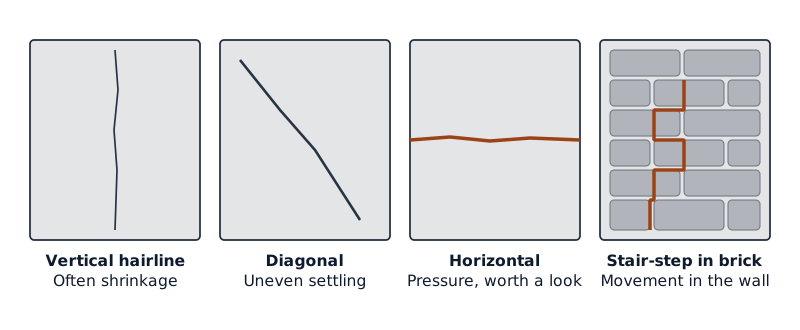
Wall cracks are easiest to sort by shape and position. Hairline cracks wander through paint or plaster. Seam cracks run dead straight along drywall joints. Pops are small round bumps over fasteners. Ceiling-line gaps sit where a partition meets the ceiling. Diagonal cracks start at a door or window corner. Stair-step and horizontal cracks follow mortar joints in brick or block.
| Crack type | Where you see it | Most likely cause | Level of concern |
|---|---|---|---|
| Hairline, random | Painted walls, old plaster | Paint or plaster shrinking, humidity swings | Low |
| Straight seam crack | Along drywall joints | Tape lifting as framing dries | Low |
| Nail or screw pop | Small circles in a row | Wood shrinking away from the board | Low |
| Ceiling-line gap | Top of interior partitions | Roof trusses lifting | Low to medium |
| Diagonal from an opening | Corners of doors and windows | Header shrinkage, or a slab or pier settling | Medium, rising if it grows |
| Stair-step in brick | Exterior veneer mortar joints | One part of the foundation moving | Medium to high |
| Horizontal in block or brick | Mid-height of masonry walls | Sideways soil or water pressure | High |
How can you tell a cosmetic wall crack from a structural one?
Width, change over time and pattern decide it. The UK's Building Research Establishment classes cracks up to about 5 mm (roughly 3/16 inch) as aesthetic damage that needs only redecoration. Wider cracks affect weathertightness and how doors and windows work, and the widest suggest a stability problem. A crack that is still growing counts for more than its width alone.
The scale is a guide, not a diagnosis, but it is a useful way to log what you see:
- Up to about 5 mm: fill, tape and repaint, then watch.
- Wider than that, or doors and windows starting to bind: the building is moving enough to affect how it works. Get the foundation looked at.
- Very wide cracks, bulging or leaning walls: a structural matter for a contractor or engineer.
Also look at the shape. A tapered crack or an offset, where one face sits proud of the other, points to movement rather than shrinkage. For the slab side of this, see vertical vs horizontal foundation cracks.
What causes hairline cracks in drywall and plaster?
Most hairline cracks in drywall come from the wood behind it, not the foundation. Framing lumber shrinks across its grain as it dries, so studs get thinner while staying the same length. That pulls fasteners loose and lifts joint tape. Seasonal humidity keeps the wood moving a little every year, which is why the same seam can open in one season and close in another.
The National Research Council Canada notes that differential shrinkage commonly shows up around windows and doors, where the header pulls away from the studs beside it. That leaves a short diagonal corner crack in a newer house with no foundation problem at all.
Two more framing-driven types are worth knowing:
- Truss uplift. Roof trusses arch upward when the top and bottom chords hold different amounts of moisture. The ceiling lifts off the top of interior walls and leaves a gap along the corner. The same digest reports gaps of up to 20 mm (about 3/4 inch) in severe cases.
- Plaster cracking in older houses. Many homes in Houston Heights are early 1900s pier-and-beam bungalows. Plaster on wood lath is brittle and cracks in fine webs as the floor framing and piers shift through wet and dry spells.
The detail of reading and fixing drywall cracks is on cracks in sheetrock walls.
Which wall cracks point to foundation movement in Houston?
The cracks that most often point to the foundation are diagonal cracks from several doors and windows on one side of the house, stair-step cracks in exterior brick, and cracks that line up inside and out. They usually come with sticking doors, gaps above trim and floors that slope toward one corner. One crack alone is rarely conclusive.
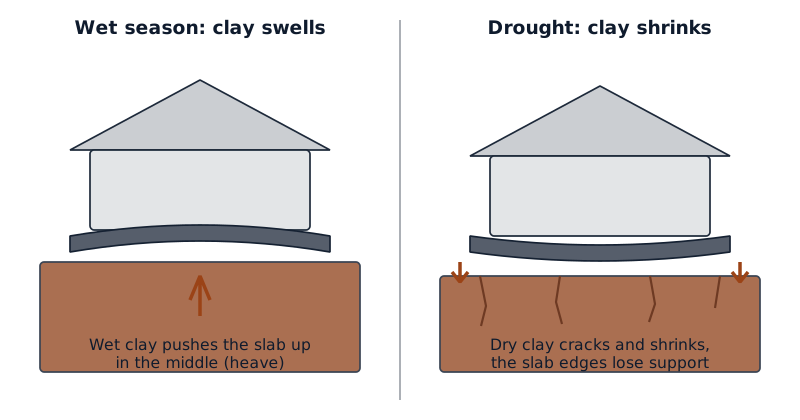
Houston's soil is the reason these show up so often. The USDA describes Lake Charles clay, common across southeast Texas, as 45 to 60% clay that cracks 1/2 to 2 inches wide at the surface when dry. As that clay swells and shrinks, the edges of a slab move more than the middle, and the walls above take the strain.
A quick check you can do in ten minutes:
- Stand outside the room where the crack is. Look for a matching stair-step crack in the brick or a gap at the window frame.
- Open and close each door on that side. Note any that rub or will not latch.
- Put a marble or a phone level app on the floor near the crack.
- Pencil a line and the date at each end of the crack and photograph it beside a tape measure.
If the crack grows past your marks in a few weeks, or the outside matches the inside, the movement is coming from below.
Are horizontal cracks in walls serious?
Horizontal cracks in masonry walls are usually the most serious type, because they suggest soil or water pressing sideways against the wall. In much of the country they show up in a basement wall holding back wet soil. In a Houston drywall wall, though, a horizontal line is usually just a sheet seam, which is far less worrying.
Houston homes almost never have a basement. Most sit on a concrete slab or, in older areas, on piers. Here a horizontal crack tends to appear in a retaining wall, block skirting on a pier-and-beam house, or brick just above the slab. If it bulges or keeps widening, have it seen before you fill it. Check first whether an interior horizontal crack lines up with a joint where two drywall sheets meet.
Can moisture cause cracks in walls?
Yes, moisture causes cracks in two ways. Humidity changes swell and shrink the wood framing, which opens seams and pops fasteners. Water in the ground is the bigger driver in Houston: wet clay swells and lifts a slab, and dry clay shrinks and lets it drop. Slab leaks, poor drainage and dry summers all show up as wall cracks.
Sealing exterior cracks keeps rain out of the wall, but waterproofing does nothing about the movement that opened them. Drainage and gutters that send water away from the slab often matter more than anything you put in the crack. See foundation drainage for how that is set up.
What should you do about each type of wall crack?
Patch the framing and humidity cracks yourself, and have the movement cracks checked first. Hairline cracks, seam cracks and nail pops are a weekend job with tape, compound and paint. Diagonal cracks that grow, stair-step brick cracks and horizontal masonry cracks need someone to find the cause before anything is filled, or the patch will crack again.
As a guide, sealing a single foundation crack runs about $250 to $800 nationally, a Houston foundation inspection about $300 to $1,000, and a typical Houston repair with piers about $3,300 to $6,800. A local contractor prices your house after seeing it. If the slab or piers need work, the City of Houston requires a building permit for foundation repair, so ask who will apply for it before work starts. Choosing a filler for the cosmetic cracks is covered on filler for cracks in walls.
When a crack looks like more than a finish problem, the guide to structural cracks in walls gives the width, shape and pattern to check.
Questions people ask
Are cracks in the walls of a new house normal?
Some are. In the first year or two, framing lumber dries out and shrinks, which opens drywall seams, pops fasteners and makes short diagonal cracks above doors and windows. These are usually cosmetic and are best fixed once, after the wood has settled. Cracks that keep widening, repeat across several openings, or come with sticking doors deserve a foundation check even in a new home.
What does a crack that is wider at the top mean?
A crack that tapers, wider at one end than the other, often means part of the wall is rotating or dropping rather than simply shrinking. In brick veneer, a crack wider at the top near a corner can point to that corner of the slab settling. Measure both ends and date them. If the wide end keeps growing, have the foundation checked before you patch.
Why do my wall cracks open and close with the seasons?
Cracks that open and close usually follow moisture. Framing takes on humidity in the wet months and dries in the cool, dry ones, so seams move a little each year. In Houston the clay under the slab does the same on a larger scale, shrinking in dry summers and swelling after heavy rain. A crack that moves but never grows overall is often seasonal.
Should I fill a wall crack before selling my house?
Fill cosmetic cracks if you like, but do not hide a crack that is still moving. A buyer's inspector looks for patched cracks, sticking doors and sloping floors, and a patch that reopens looks worse than an honest record. If you think the crack is structural, a foundation inspection gives you something in writing to show buyers.
Do cracks in brick walls let water in?
They can. Brick on a house is a thin outer skin, and an open crack lets rain through to the wall behind it and around the window frames. Small mortar cracks can be repointed. A stair-step crack that keeps widening means the slab under that wall is moving, so it needs the cause fixed first or the new mortar will crack along the same line.
This guide is one of many on Foundation Repairs Houston Quotes.
Sources
- BRE Group, assessing cracks in houses (summary of BRE Digest 251)
- National Research Council Canada, Canadian Building Digest 244, Effects of Wood Shrinkage in Buildings
- Building Science Corporation, RR-0107 Drywall, Wood and Truss Uplift
- USDA NRCS, Lake Charles soil series description
- This Old House, foundation repair cost guide (October 2026)
- Houston Press, guide to foundation repair in Houston (2026)
- City of Houston weekly building permit report, July 2024
- Houston Heights design guidelines, City of Houston Planning
Last changed