A typical mudjacking job costs about $550 to $1,300, according to This Old House's 2026 cost guide. Priced by area, national guides put it at roughly $3 to $8 per square foot, so a single 10 by 10 foot panel can be lifted for a few hundred dollars while a long run of driveway costs more. The size of the sunken area, how far it has dropped and the void underneath decide most of the price. For how the work itself is done, see mudjacking and slab lifting in Houston. This page covers average prices, driveway and patio costs, what moves a quote, and how grout compares with foam and replacement.
What is the average cost of mudjacking?
Most homeowners pay between $550 and $1,300 to have a sunken slab raised with cement grout, based on This Old House's national figures updated in 2026. A second national guide, Inch Calculator, puts the average concrete leveling job near $950, with most falling between $500 and $1,500. A single sidewalk square sits at the bottom of that band. A garage floor or several driveway panels sit at the top.
| Job | Typical range | Source |
|---|---|---|
| Mudjacking or slabjacking, typical job | $550 to $1,300 | This Old House, 2026 |
| Concrete leveling, average job | $500 to $1,500 | Inch Calculator |
| Mudjacking, per square foot | $3 to $8 | Inch Calculator |
| Mudjacking, 100 sq ft area | $300 to $800 | Inch Calculator |
| Polyurethane leveling, per square foot | $20 to $25 | Fixr, 2025 |
| Driveway leveling, 600 sq ft, grout or foam | $3,000 to $15,000 | Fixr, 2025 |
These are national guides, so treat them as a starting point.
How much does mudjacking cost per square foot?
National guides put mudjacking at about $3 to $8 per square foot, materials and labor together. That makes a 100 square foot area roughly $300 to $800. Small jobs often cost more per foot, because setting up the pump and crew costs much the same whatever the size.
Per square foot is a rough tool. Two slabs of the same size can need very different amounts of grout if one has a deep hollow underneath and the other has barely moved. Many contractors price by the job rather than the foot. The mudjacking cost per square foot page goes into the arithmetic in more detail.
What does it cost to mudjack a driveway?
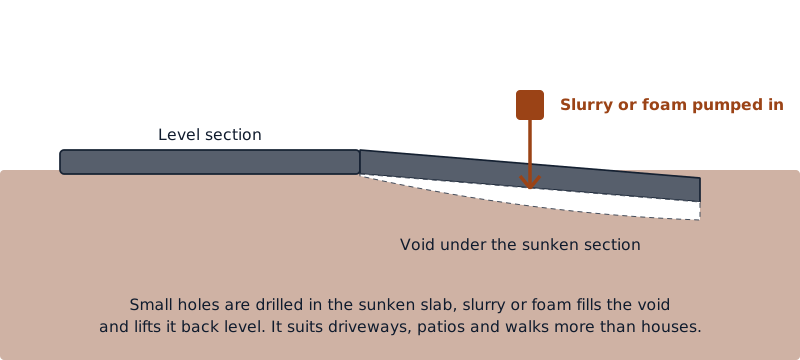
Driveways vary more than any other job. Lifting one or two sunken panels near the garage usually falls inside the typical $550 to $1,300 range. Raising a whole 600 square foot driveway is a bigger job: at $3 to $8 a square foot that works out to about $1,800 to $4,800, and Fixr's driveway figure, which includes foam jobs, runs from $3,000 to $15,000.
Usually only part of a driveway has dropped, often the garage apron where downspouts dump water, so only those panels are lifted.
After the lift, a Houston guide says the grout needs 24 to 72 hours to cure, so plan on keeping cars off for that time.
How much does mudjacking a patio, sidewalk or garage floor cost?
A sunken patio or sidewalk panel is usually one of the cheapest mudjacking jobs, often a few hundred dollars for 100 square feet at the national $3 to $8 rate. A garage floor costs more because it is larger and carries a car. Pool decks and steps are priced case by case, since access and the risk of cracking thin edges change the work.
- Patio. A 200 square foot patio at $3 to $8 a square foot comes to about $600 to $1,600 in grout and labor if the whole area needs lifting.
- Garage floor. These often drop at the door edge where rain runs in. Expect the upper half of the typical range or more.
- Steps and stoops. Heavy and awkward to lift evenly; some are cheaper to rebuild.
Fixr notes that mudjacking suits slabs about 3 to 6 inches thick, which covers most residential flatwork.
What makes a mudjacking quote higher or lower?
Five things move the price: the area to lift, how far it has sunk, the size of the void underneath, access for the pump, and whether the slab is cracked. A large hollow takes far more grout than a slab that dropped half an inch. If the pump has to sit far away, Fixr says distances beyond about 200 to 250 feet add cost.
Other things that push a quote up:
- Broken slabs. Concrete in several pieces may need each piece lifted on its own, or may not lift cleanly at all.
- Joint sealing and hole patching. Some quotes include caulking the joints after the lift so water can't wash the new grout out. Others charge extra.
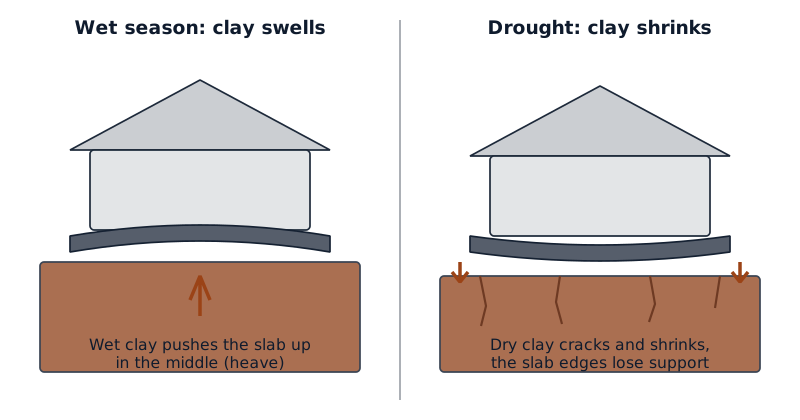
The ground matters too. The USDA describes Houston's Lake Charles clay, first mapped in Fort Bend County near Sugar Land, as cracking up to two inches wide in dry spells, and says water enters those cracks fast. That is how voids open under flatwork here. Good foundation drainage around the slab keeps a lift from failing early.
Is mudjacking cheaper than foam or replacing the slab?
Mudjacking is usually the cheapest way to raise sunken concrete. Fixr puts polyurethane foam leveling at about $20 to $25 a square foot, several times the $3 to $8 range for cement grout. Replacing the slab outright costs more again: Fixr says a new slab runs 50 to 70% more than leveling, before you count the mess of tearing out the old one.
Foam is a much lighter material and goes in through smaller holes, which some Houston homeowners think is worth the difference on wet Gulf Coast clay. The full side by side is on polyjacking vs mudjacking.
When is mudjacking the wrong fix for a Houston home?
Mudjacking lifts flatwork that has dropped into a void. It does not stop the soil under a house from moving. If your house slab is sinking at a corner or along a wall, grout only fills the gap, and expansive clay keeps swelling and shrinking under it. That kind of settling needs foundation piers that reach firmer ground.
Subsidence is a second limit. The Harris-Galveston Subsidence District measured the fastest regional sinking, over 3 cm a year, around Katy and Fulshear. A grout lift corrects one panel dropping against its neighbors, not land sinking over a wide area.
If the problem is the house rather than the driveway, compare foundation leveling cost first. When you ask for a quote, we'll arrange a visit from a local foundation contractor who can see which fix applies. The figures here are a guide; the contractor gives the real price in writing after the visit.
Questions people ask
How long does mudjacking take?
Most residential mudjacking jobs take a few hours, and a single driveway or patio is usually finished in one visit. Fixr gives typical labor time on a small job as one to two hours. The grout then needs time to cure: a Houston guide says 24 to 72 hours, so keep vehicles off a lifted driveway until the contractor says it's ready.
How long does mudjacking last?
It depends mostly on water. Grout that stays dry and supported can hold a slab for years, but if rain keeps running under the edge, it can wash soil out again and the slab drops. Sealing the joints and sending downspouts away from the concrete are the cheapest ways to make a lift last on Houston clay.
What should I ask before hiring someone for mudjacking?
Ask what the price includes: the number of holes, patching, joint sealing and cleanup. Ask how high they expect to lift the slab, what happens if it cracks, and when you can drive on it. Get the answers in writing with the price, and compare two quotes for the same areas.
Do I need to be home during mudjacking?
Usually not for the whole job, as long as the contractor can reach the slab and a water supply. It helps to be there at the start to agree which panels are lifted and at the end to check the result. Clear a garage floor first.
Budget sorted? foundation repair houston explains the rest of the job.
Sources
- This Old House, foundation repair cost guide (October 2026)
- Inch Calculator, concrete slab leveling cost guide
- Fixr, concrete leveling cost guide (January 2025)
- Houston Press, guide to foundation repair in Houston (2026)
- USDA NRCS, Lake Charles soil series description
- Harris-Galveston Subsidence District, 2025 annual groundwater report summary
Last changed