Polyjacking lifts sunken concrete with expanding polyurethane foam; mudjacking lifts it with a pumped cement grout. For most Houston driveways, sidewalks and patios, foam is the stronger pick where water keeps getting under the slab, because it is light, goes in through small holes and is built to shrug off soil moisture. Mudjacking still makes sense for large voids and tighter budgets. Both are forms of concrete lifting, and neither fixes a house that is sinking on deep clay. This page compares the two side by side, covers price and lifespan, and says when a visit makes more sense than either. For the grout method on its own, see mudjacking in Houston.
Is polyjacking or mudjacking better for a Houston slab?
For flat concrete that keeps getting wet, polyjacking is usually the better choice in Houston. The foam is hydrophobic, light and needs smaller holes, so it suits patios and driveways on clay that soaks up every storm. Mudjacking is the better buy when the void underneath is large, because grout is the cheaper filler by volume. If the slab is a house foundation dropping at one corner, neither method solves the cause.
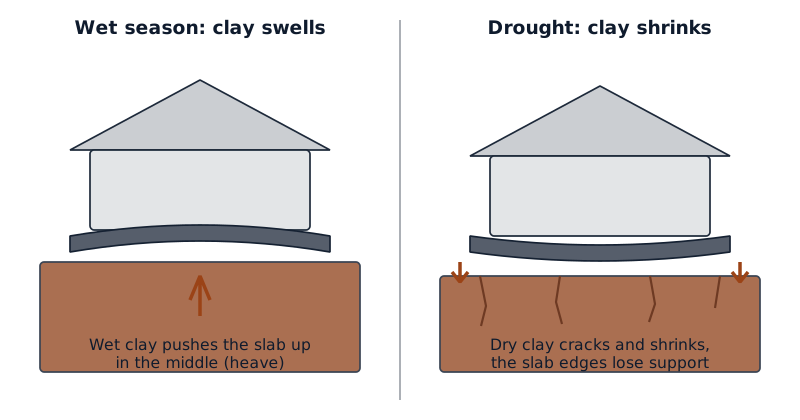
The real question is why the concrete dropped. Houston slabs sink for three common reasons:
- Washout. Water from a downspout or a low spot carries soil away from under the edge. Foam resists that water better, but the drainage still has to be fixed or the next storm repeats the damage.
- Shrinking clay. Lake Charles clay, the USDA soil series named from Fort Bend County near Sugar Land, is 45 to 60% clay, and in dry spells its surface splits open for weeks at a time. Concrete on top follows it down.
What is the difference between polyjacking and mudjacking?
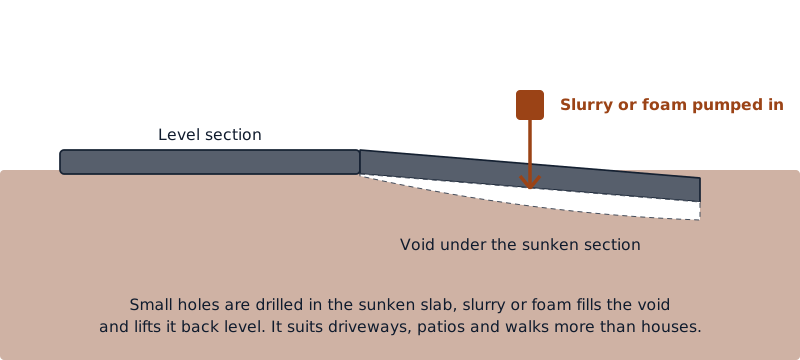
The difference is the material pumped under the slab. Mudjacking uses a wet grout of soil or fine sand, Portland cement and water, forced in through holes about 2 5/8 inches across on highway work. Polyjacking injects a two-part polyurethane that expands and hardens, through holes of roughly 9/16 to 3/4 inch. Both are concrete leveling methods that raise the existing slab instead of replacing it.
The Missouri Department of Transportation, which uses both on its roads, gives the clearest public description of each:
- Mudjacking grout is selected topsoil or loam with cement, made a little runnier to fill voids and stiffer to lift. Crews raise the slab no more than 1/4 inch at each hole at a time, moving between holes so it rises evenly.
- Polyurethane for slab lifting is a water blown, closed cell, high density foam, and the department requires it to be hydrophobic so soil moisture and free water under the pavement don't weaken it. Flow is controlled through a pressure gauge as the foam expands.
MoDOT also says foam should not be used to fill large voids, which matters if there is a big hollow under your patio.
How do polyjacking and mudjacking compare side by side?
Foam wins on hole size, weight, water resistance and how soon you can use the slab. Grout wins on filling big voids and, often, on material cost. Both lift a whole slab back toward level when the concrete is in sound pieces, and both leave patched holes behind. The table sets out the main points, with the source for each.
| Mudjacking | Polyjacking | |
|---|---|---|
| Material | Soil or sand, Portland cement and water (MoDOT) | Expanding two-part polyurethane foam |
| Injection holes | About 2 5/8 inches on highway work (MoDOT) | About 9/16 to 3/4 inch (MoDOT) |
| Load on the soil | Heavy wet grout adds weight | Light foam adds little |
| Water under the slab | Can wash out if drainage stays poor | Hydrophobic by specification (MoDOT) |
| Large voids | Suits them | Not recommended for large voids (MoDOT) |
| Back in use | 24 to 72 hours to cure (Houston guide) | As soon as 15 minutes, per a national guide |
| Typical price | $550 to $1,300 per job (national guide) | No reliable published range; get it quoted |
| Look afterward | Fewer, larger patches | More small patches |
The weight point is worth a moment in Houston. Heavy grout sitting on soft, wet clay adds load to the very soil that let the slab drop. Light foam adds far less.
Which costs more, mudjacking or polyjacking?
Mudjacking usually costs less up front, and published guides disagree on foam. This Old House puts mudjacking or slabjacking at $550 to $1,300 for a typical job. It describes polyurethane injection as less time consuming and less expensive, while MoDOT limits foam to small voids because of its material cost. The honest answer is that the void size under your slab decides which comes in cheaper.
What moves the price on either method:
- Area and how far it dropped. A single sidewalk panel is a short job; a full driveway or garage floor takes longer.
- Void size. A big hollow eats material. That tips the balance toward grout, since MoDOT limits foam to small voids because of what the material costs.
- Extra work. Joint sealing and a downspout extension add a little but protect the lift.
These figures are a guide only, and the written quote sets your price. We'll arrange a visit and you get that quote before any drilling starts. Ask for a slab lifting quote.
Which lasts longer on Houston clay?
Neither has a published lifespan you can rely on, because the ground decides how long a lift holds. If the soil under the slab has finished settling and water is kept away, either can hold for many years. If runoff keeps scouring the base or the clay keeps shrinking and swelling, the slab can drop again with either method.
Foam has the edge where water is the cause; grout has it where a large void needs bulk fill. What makes a lift last in Houston:
- Point downspouts away from the slab and extend them past its edge.
- Seal the joints between panels so rain can't run straight under them.
- Fix low spots in the yard that send water toward the concrete.
- Keep the soil moisture even in dry summers, because cracked clay drinks water fast and swells.
More on keeping water away from the house is on foundation drainage.
When should you skip both and have a professional check the foundation?
Skip slab lifting and get a foundation check when the problem is the house, not the driveway. Cracks running diagonally from door corners, doors that bind, gaps where the brick meets the trim, or floors that slope inside all point to movement under the foundation itself. Pumping foam or grout under a house slab fills a void but does nothing to stop deep clay moving.
A local foundation contractor will usually recommend foundation piers for a house slab that has dropped at a corner or along a wall, since piers reach firmer soil below the active clay. The full set of options is on slab foundation repair, and lifting a whole house back to level is covered on foundation leveling.
Some homes have nothing to lift. City planning guidelines describe most older Houston Heights houses as wood framed on pier and beam, so the floor sits over a crawl space, not on a slab. Those need pier and beam foundation repair.
If you can't tell whether the slab or the house is moving, a foundation inspection sorts it out. A Houston guide puts inspections at $300 to $1,000, with about $600 as the average.
Questions people ask
How long does polyjacking vs mudjacking take?
Both lifts usually finish within a day for a driveway, sidewalk or patio. The difference comes after. A Houston guide says mudjacking slurry needs 24 to 72 hours to cure before it carries weight, while a national guide says foam lifted concrete can be used in as little as 15 minutes. If you can't keep a car off the driveway for two or three days, foam is easier to live with.
What should I ask before I hire someone for polyjacking or mudjacking?
Ask which material they plan to use and why it suits your void, how many holes they will drill and how wide, and how they will watch the level as the slab rises. Ask how long before you can drive on it, what happens if the slab settles again, and whether the price covers sealing joints and patching holes. Get every part of it in writing.
Do I need to be home for polyjacking or mudjacking?
Usually not for the whole job. The contractor needs clear access to the slab, vehicles moved, and power or water if their rig needs it. Being there at the start lets you agree the finished height, and being there at the end lets you check the result. For a garage floor, someone has to open the garage.
Can polyjacking or mudjacking fix a cracked slab?
They can lift and support a cracked slab, but they don't repair the crack. Lifting can close a step at a joint and stop a trip edge, and the crack is then sealed separately. MoDOT notes that badly broken slabs can't be raised effectively, so concrete in many loose pieces is usually better replaced than lifted.
More services are listed on Foundation Repairs Houston Quotes.
Sources
- Missouri Department of Transportation, Engineering Policy Guide 570.5, Mudjacking (Slab Jacking)
- This Old House, foundation repair cost guide (October 2026)
- Houston Press, guide to foundation repair in Houston (2026)
- USDA NRCS, Lake Charles soil series description
- Houston Heights design guidelines, City of Houston Planning
Last changed