Mudjacking lifts sunken concrete by pumping a cement grout under it through small drilled holes until the slab rises back to level. It is the oldest form of concrete leveling, and in Houston it is mostly used on driveways, sidewalks, patios, pool decks and garage floors that have dropped as the clay below dried out or washed away. A national guide puts a typical job at $550 to $1,300. Mudjacking can also fill shallow voids under a house slab, but it does not stop deep soil movement: that takes piers. This page covers how the work is done, what it costs, how it compares with foam, and when to choose something else.
What is mudjacking?
Mudjacking, also called slabjacking, is a way of raising a settled concrete slab without tearing it out. A contractor drills holes through the concrete, then a pump pushes a slurry of soil or fine sand, Portland cement and water underneath. The grout fills the empty space first, then builds pressure and lifts the slab. Once it is level, the holes are packed with mortar.
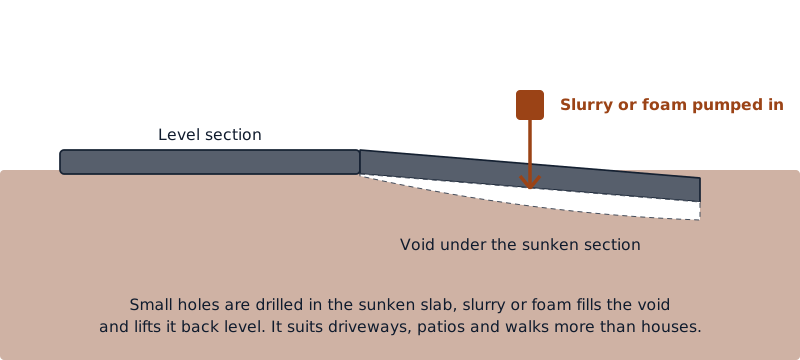
The Missouri Department of Transportation, which mudjacks highway slabs, describes the grout as topsoil or loam mixed with cement, with fine sand used where good loam isn't available.
The wider terms concrete lifting and concrete leveling cover mudjacking and its newer rival, polyurethane foam injection, sometimes sold as "foam mudjacking" or polyjacking.
Can mudjacking fix a house foundation in Houston?
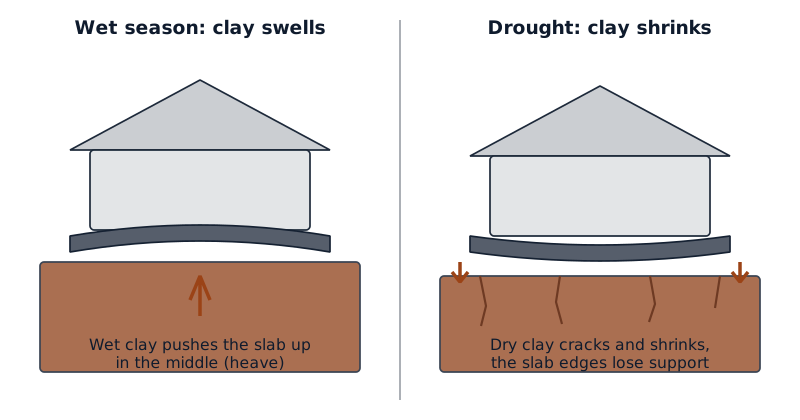
Sometimes, but only for shallow problems. A national cost guide notes that shallow settling might only need mudjacking, while deep soil stability problems need piers. Under a Houston house, the cause is usually deep: expansive clay that swells and shrinks with the seasons. Grout fills the gap left by that movement, but it does nothing to stop the clay moving again.
The USDA describes the Lake Charles clay, first mapped in Fort Bend County around Sugar Land, as 45 to 60% clay that cracks up to two inches wide and a foot or more deep in dry spells. A slab lifted with grout still sits on that moving soil.
So for a house sinking along a wall or at a corner, a local foundation contractor will usually recommend foundation piers that reach firmer ground, with grout at most filling voids alongside them. The options are set out on slab foundation repair. Inside the City of Houston, foundation repair on a house runs under a building permit.
Older homes such as the Craftsman bungalows in the Houston Heights sit on pier and beam over a crawl space. With no slab to lift, mudjacking doesn't apply; see pier and beam foundation repair.
How does mudjacking work, step by step?
A mudjacking job runs in five steps: mark out the sunken area, drill injection holes, pump grout under the slab a little at a time, check the level as it rises, then plug and patch the holes. A driveway is usually done in a day, then the grout cures.
- Lay out the holes. Grout spreads in roughly every direction, so holes go at even spacings.
- Drill. Mudjacking holes are larger than foam holes. MoDOT's highway mudjack holes are about 2 5/8 inches across; home work often uses smaller ones, but they are still bigger than the 9/16 to 3/4 inch holes used for polyurethane.
- Pump. A mudjack pump forces the grout under the slab. MoDOT works outward from the deepest point, lifting no more than 1/4 inch at each hole at a time.
- Watch the level. The slab is checked with a string line or level as it rises, because lifting too far in one spot cracks it.
- Patch. Each hole is filled with a cement and sand mortar.
A Houston guide says mudjacking slurry needs 24 to 72 hours to cure, so plan to keep cars off a lifted driveway for that long.
Mudjacking vs polyurethane foam: which is better?
Neither is better in every case. Mudjacking uses a heavy cement grout and larger holes, and is often the cheaper choice for big voids. Polyurethane foam is lighter, goes in through smaller holes and resists water better. For a Houston driveway on wet clay, foam's resistance to washout counts for a lot, but the price difference decides many jobs.
| Mudjacking | Polyurethane foam | |
|---|---|---|
| Material | Soil or sand, Portland cement and water | Expanding two-part polyurethane |
| Hole size | Larger, up to about 2 5/8 inches on highway work | About 9/16 to 3/4 inch |
| Weight under the slab | Heavy | Light |
| Water | Less resistant to washout | Hydrophobic, designed not to be weakened by soil moisture |
| Large voids | Suits them | MoDOT limits it to small voids because of cost |
| Cure before use | 24 to 72 hours (Houston guide) | Ask the contractor |
Price guides disagree on which costs less, so get both priced for your slab. The longer comparison is on polyjacking vs mudjacking.
How much does mudjacking cost in Houston?
This Old House puts mudjacking and slabjacking at $550 to $1,300 for a typical job, based on national figures updated in 2026. The size of the sunken area, how far it has dropped, how big the void is underneath and how easy it is to reach decide where your job lands. A small sidewalk panel sits at the low end; a long driveway or a garage floor costs more.
| Item | Typical range | Source |
|---|---|---|
| Mudjacking or slabjacking, typical job | $550 to $1,300 | National guide, 2026 |
| Foundation inspection | $300 to $1,000 | Houston guide, 2026 |
| Pressed concrete pier, each | $300 to $600 | Houston guide, 2026 |
| Typical Houston foundation repair job | $3,300 to $6,800 | Houston guide, 2026 |
A slab that keeps sinking after grout often ends up needing the inspection and piers too. These figures are a guide; the written quote sets the real price. For a fuller breakdown, see mudjacking cost in Houston, and for lifting a whole house slab, foundation leveling cost.
What can be mudjacked: driveways, sidewalks and patios?
Most flat concrete around a Houston home can be mudjacked: driveways, sidewalks, front steps, patios, pool decks, garage floors and the apron where the driveway meets the street. The slab needs to be in fairly whole pieces and to have dropped rather than heaved up. Concrete that has been pushed up by swelling clay or tree roots can't be pushed back down with grout.
Common reasons people call for it:
- A driveway panel has dropped and left a trip edge at a joint.
- The garage floor has sunk away from the door.
- A patio slopes back toward the house, sending rain to the foundation.
- Voids show under the slab edge where soil has washed out.
A patio that tips toward the house is worth fixing quickly: water pooling there feeds the clay under the foundation.
Can you do mudjacking yourself?
You can, on small jobs like a single sidewalk panel, but it's harder than it looks. You need a drill for concrete, a grout pump or rented mudjacking equipment, a steady mix and patience. Lifting too fast or too far cracks the slab, and an overfilled void can lift the wrong section. For a driveway or anything touching the house, hire it out.
The tools and risks are on DIY mudjacking. Otherwise, we'll arrange a visit from a local concrete leveling contractor, and you get a written price before any drilling starts. Ask for a mudjacking quote.
Questions people ask
How long does mudjacking take?
The lifting itself usually takes a few hours for a driveway, sidewalk or patio, and most residential jobs finish in a day. The grout then has to cure. A Houston guide puts that at 24 to 72 hours, so keep vehicles off a lifted driveway until the contractor says it is ready.
How long does mudjacking last?
It depends mostly on what made the slab sink. If the soil settled once and has stopped, a lift can hold for many years. If water keeps washing soil away or the clay keeps moving, the slab can drop again. Fixing gutters and drainage around the slab matters as much as the grout.
What should I ask before I hire someone for mudjacking?
Ask whether they use cement grout or foam and why, how many holes they'll drill and how big, how they'll check the level, and how long before you can drive on it. Ask what written terms come with the work if the slab settles again, and get the full price in writing. For a house foundation, ask whether piers would be the better fix.
Do I need to be home for mudjacking?
Not always. For a driveway, sidewalk or patio, the contractor mostly needs clear access, cars moved out and a water spigot. It helps to be there at the start to agree the finished level and at the end to see the result. Work inside a garage needs someone to open it.
Does mudjacking leave holes in the concrete?
Yes. Every injection hole stays visible after patching, usually as round gray spots, because new mortar rarely matches weathered concrete exactly. Mudjacking holes are larger than polyurethane foam holes, so they show more. If looks matter, ask how many holes your job needs and how they'll be finished.
Can mudjacking fix cracked concrete?
Not on its own. Mudjacking lifts and supports a slab, which can close a gap at a joint, but it doesn't repair the crack itself. The crack still needs filling or sealing afterward. MoDOT notes that badly broken slabs can't be raised effectively, so concrete in several loose pieces is usually replaced instead.
Read on
- Diy foam foundation repair
Can you lift concrete or a Houston slab with a DIY polyurethane foam kit?
- DIY mudjacking concrete
How to mudjack a sunken sidewalk or patio slab yourself: the grout mix, the pump, hole layout, the 1/4 inch lift rule, and where DIY…
- Costs
What mudjacking costs in Houston, per square foot and per job, for driveways, patios and garage floors, what moves the price and when foam…
- Mudjacking and slab lifting
Polyjacking vs mudjacking compared for Houston driveways, patios and slabs: materials, hole size, cure time, cost and which one suits wet…
Every service and price guide is on Houston foundation repair.
Sources
- Missouri Department of Transportation, Engineering Policy Guide 570.5, Mudjacking (Slab Jacking)
- This Old House, foundation repair cost guide (October 2026)
- Houston Press, guide to foundation repair in Houston (2026)
- USDA NRCS, Lake Charles soil series description
- City of Houston weekly building permit report, July 2024
- Houston Heights design guidelines, City of Houston Planning
Last changed