Cracks in interior walls are most often the house framing and wallboard moving a little, and a single fine crack in one room rarely means anything structural. What tells you more is the pattern across the whole house. Cracks in several rooms on the same side, cracks that keep coming back after patching, or cracks that show up with sticking doors usually point to the slab or piers moving on Houston clay. This page shows you how to map the cracks room by room, read what the pattern says, and decide who should look at it. For crack repair methods and costs, start with our foundation crack repair guide.
What do cracks in interior walls mean?
Cracks in interior walls mean something in the house has moved enough to split the drywall or plaster. In most homes that movement is small: lumber drying out, seasonal humidity, or a seam that was taped thinly. When the cracks are wide, keep growing, or cluster on one part of the house, the movement is more likely coming from below, where the foundation sits on clay that swells and shrinks.
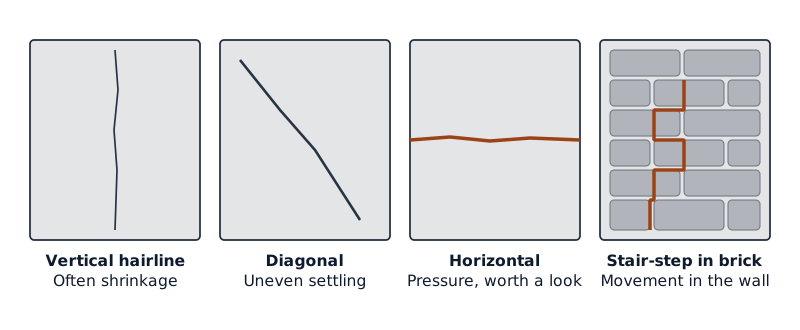
The wall finish is the weakest part of the building, so it shows movement first. A crack in sheetrock is a symptom, not a diagnosis. The useful question is not "is this crack bad" but "what moved, and is it still moving".
A dozen small cracks, mapped and dated, tell you far more than one. Our types of cracks in walls guide covers what each single crack shape means. This page is about reading them together.
Why do inside walls crack when the outside of the house looks fine?
Inside walls often crack first because drywall is far more brittle than brick veneer or siding, and interior partitions sit across the middle of the slab, where movement differs from the edges. A slab that rises or drops a fraction of an inch in one area can split taped joints over doors long before the brick outside shows a stair-step crack.
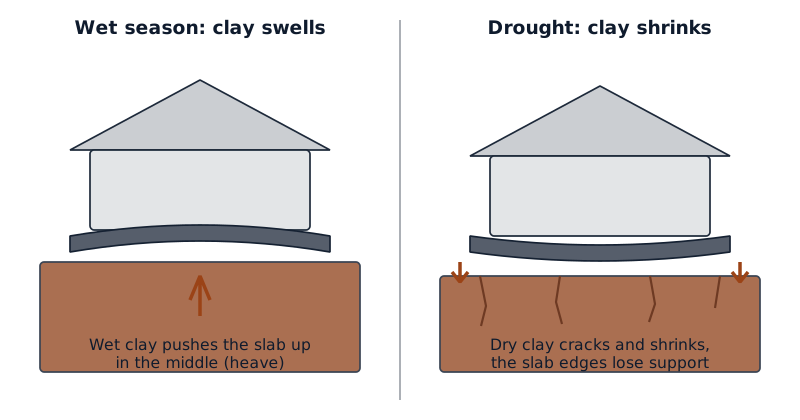
Much of greater Houston sits on clay. The USDA describes Lake Charles clay, common between the Colorado and Trinity rivers, as 45 to 60% clay, with surface cracks 1/2 to 2 inches wide when it dries out. When the soil under one part of a slab dries and shrinks while another part stays wet, the slab bends. The walls sitting on it go out of square, and the drywall seams give way.
Interior walls also carry framing that shrinks on its own. The National Research Council Canada notes that headers over doors and windows shrink away from the studs that support them, and that shrinkage can pull nails and pop the compound over their heads. So an inside wall can crack from the wood alone, the ground alone, or both at once.
How do you map the cracks in your house room by room?
Map the cracks by sketching a simple floor plan, walking every room, and marking each crack with its location, direction, length and widest point. Date the ends with a pencil mark and take a photo with a ruler beside it. Then repeat the walk after four to six weeks and again after a change of season, so you can see which cracks are growing.
- Draw the plan. A rough sketch on paper is enough. Mark north, the garage, and any addition.
- Walk every room. Check walls, the line where walls meet the ceiling, and the corners of every door and window. Closets and hallways count.
- Mark each crack. Note whether it is vertical, diagonal or horizontal, and which way a diagonal leans.
- Measure the widest point. Use a ruler with millimeter marks or a crack-width card, and write the number on your plan.
- Pencil the ends. A short line and the date at each end shows you later if the crack has run further.
- Check doors and floors in the same rooms. Note any door that rubs or will not latch, and roll a marble across hard floors.
- Look outside on the same side. Brick cracks, gaps at window frames, or soil pulled back from the slab edge belong on the plan too.
What does the pattern of cracks across your home tell you?
The pattern tells you whether the cause is local or the whole structure. Cracks scattered randomly, each fine and short, usually come from framing and finishes. Cracks that line up on one side of the house, or around the middle of it, usually come from the slab or piers moving. Cracks near wet rooms point to water. Cracks along one joint point to where two parts of the building meet.
| Where the cracks are | What it usually points to | What to do first |
|---|---|---|
| One room, one short fine crack | Framing shrinkage or a weak tape joint | Patch after a full season of no change |
| Along the wall to ceiling line of inside walls | Roof trusses lifting, or framing movement | Flexible repair, not a foundation job |
| Several rooms, all on one side of the house | That edge of the slab dropping as the clay dries | Map it, then book a foundation check |
| Hallway and middle rooms, doors out of square | Movement in the middle of the slab | Book a foundation check |
| Bathroom, kitchen or laundry walls, with stains | A plumbing or condensate leak | Find the water before anything else |
| Where an addition or the garage meets the house | Two foundations moving separately | Have a contractor look at the joint |
Cracks along the wall to ceiling line deserve a note. Building Science Corporation explains that roof trusses can rise when their top and bottom chords sit at different moisture levels, pulling the ceiling away from the interior partitions. The fix is a flexible or floating corner, and the slab is not involved. Our guide to fixing cracks in a drywall ceiling covers that repair.
Can moisture inside the house crack interior walls?
Yes. Moisture cracks interior walls in two ways. Water that soaks drywall or plaster softens the board and lifts the tape, so cracks open along the joints near the leak. Water that escapes under the house, from a plumbing leak in or below the slab, can wet the clay in one spot, swell it, and push that part of the floor up. Either way the cracks gather near wet rooms.
Look for stains, soft spots, peeling paint or swollen baseboards. A rising water bill with no change in use, or a warm patch on the floor, can mean a leak under the slab. Our page on slab leak symptoms walks through those signs. If water is involved, a plumber finds and stops it before any wall or foundation work starts.
A note on advice you find online. A lot of it assumes a basement, with waterproofing, sump pumps and bowed basement walls. Houston has almost no basements. Most homes here sit on a concrete slab on grade, and many older ones sit on pier and beam. Basement waterproofing does not apply. What matters here is how much water reaches the clay around and under the house, and how evenly.
Are cracks in interior walls normal in a newer house?
Some are. New framing lumber dries out after the house is closed in, and as it shrinks it can pop nails and crack seams, especially at door and window corners. These cracks are usually fine, show up in the first year or two, and stop once the wood settles to the indoor air. Wide, growing or clustered cracks in a new house are not normal and deserve a check.
The National Research Council Canada notes that shrinkage continues until the wood matches the indoor air, so a builder may patch once after the first year rather than chasing each crack.
Uneven watering of new lawns and beds can also move a slab edge in the first summers. If your new-home cracks line up on one side of the house, map them and raise it with the builder in writing while any builder warranty is still in force.
When do cracks in interior walls need a foundation contractor?
Call a foundation contractor when cracks are wider than about 1/4 inch, keep growing between checks, line up on one side or through the middle of the house, come back soon after patching, or appear with doors that stick and floors that slope. Those are signs the structure is moving, and patching the drywall will not stop it. A single fine crack you can patch yourself.
For scale, the UK's Building Research Establishment classes crack widths up to about 5 mm, just under 1/4 inch, as aesthetic damage that usually needs only redecoration, while noting that whether cracks are growing also matters. Doors that bind are covered in our guide to doors sticking.
What a visit involves: a local foundation contractor walks the house, reads your crack map, measures floor elevations room by room, and checks drainage and trees around the slab. You get the findings and a written price before any work starts. Houston guides put an inspection at about $300 to $1,000, averaging around $600, and a structural engineer's report at $500 to $1,000 if you want an independent opinion. Our foundation inspection page explains what each one covers.
Two lines where DIY stops. Patching drywall is yours to do. Leveling a slab or adding piers is not: the City of Houston requires a building permit for foundation repair, and its permit reports list residential shim and level jobs. Wait to patch the walls until any leveling is finished, since lifting the slab can open or close cracks again.
If your crack map shows a pattern, ask for a quote and we'll arrange a visit from a local foundation contractor who can measure the floors and tell you what is moving.
Questions people ask
Are cracks in interior walls normal?
Fine cracks at door corners, nail pops and short seam cracks are common in Houston homes and often come from framing shrinkage and seasonal humidity. They are normal when they stay hairline thin, do not grow over a season, and are not grouped on one side of the house. Wide, growing or clustered cracks are not normal, and long horizontal cracks are more serious, so both are worth checking.
Should I patch cracks in internal walls before foundation repair?
No. Wait until any foundation work is finished. Leveling or piering can move the walls again, so cracks may close, widen or appear in new places. Mark and photograph the cracks before the work, compare them afterward, and patch once the house has settled into its new position. Patching early often means paying for the same repair twice.
Who should look at house cracks in walls first?
If the cracks are fine, few and stable, a drywall finisher or a handy homeowner can patch them. If they are wide, growing, or grouped with sticking doors or sloping floors, start with a foundation contractor or a structural engineer. If there are stains or a high water bill, call a plumber first, because a leak can be both the cause and the reason cracks keep returning.
How long should I watch a crack in a home wall before deciding?
Watch it for at least one change of season, ideally a full summer. Houston clay shrinks most in long dry spells, so a crack that is stable in spring can widen in August. Check your pencil marks and photos every four to six weeks. If a crack grows between two checks, you do not need to wait the full season before booking a visit.
Can cracks in interior walls affect selling a house?
They can. Buyers' inspectors note wall cracks, and a cluster of them with sticking doors often leads to a request for a foundation evaluation. Having your crack map, dates and any engineer's or contractor's findings on hand helps you answer questions plainly. If repairs were done, the permit and the paperwork from the contractor matter to a buyer as much as the repair itself.
The rest of our guides start from foundation repair in Houston.
Sources
- National Research Council Canada, Canadian Building Digest 244, Effects of Wood Shrinkage in Buildings
- Building Science Corporation, RR-0107 Drywall, Wood and Truss Uplift
- BRE Group, assessing cracks in houses (summary of BRE Digest 251)
- USDA NRCS, Lake Charles soil series description
- Houston Press, guide to foundation repair in Houston (2026)
- This Old House, foundation repair cost guide (October 2026)
- City of Houston weekly building permit report, July 2024
Last changed