A concrete slab foundation in Houston is usually repaired by pressing piers into the ground under the sunken parts of the slab, then lifting the house back toward level on top of them. A cracked but stable slab may only need sealing. Most Houston foundation repair jobs cost about $3,300 to $6,800, according to a 2026 Houston guide, with the number of piers driving the price. Below: how slab repair works, the methods, the costs, the pipes and ducts under the slab, and choosing who does it.
How is a concrete slab foundation repaired in Houston?
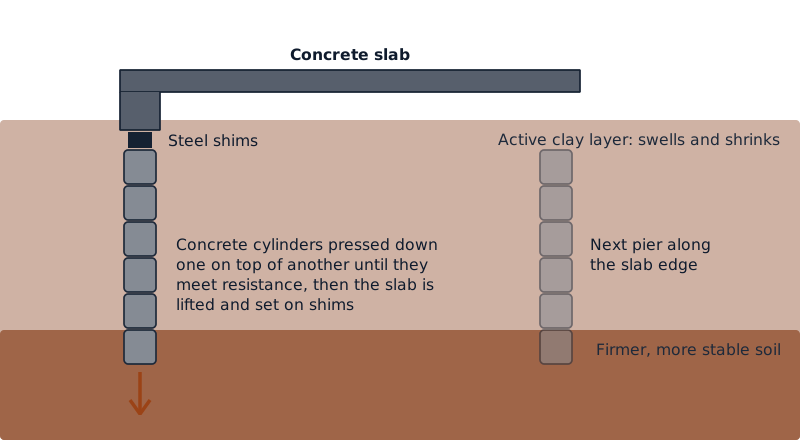
Most slab repairs here follow the same pattern. A contractor measures how far the floor has dropped, digs beside the slab edge (or breaks through the floor inside), presses piers down until they meet firm resistance, then jacks the slab up and sets it on shims. The holes are backfilled and the floor patched. The goal is to stop the movement first and lift second.
A typical slab job runs in this order:
- Elevation survey. The high and low points of the slab are mapped with a level or manometer.
- A written plan. Where each pier goes and how many. Bigger jobs may start with an engineer's report.
- Permit. In the City of Houston, foundation repair needs a building permit.
- Piers. Holes are dug at the slab edge, and inside where interior beams need support.
- Lift and backfill. The slab is raised in stages, shimmed, and the holes filled.
- Plumbing check. A test before and after the lift is common, because drain lines can be stressed.
More detail: how to repair a slab foundation.
Why do slab foundations fail on Houston soil?
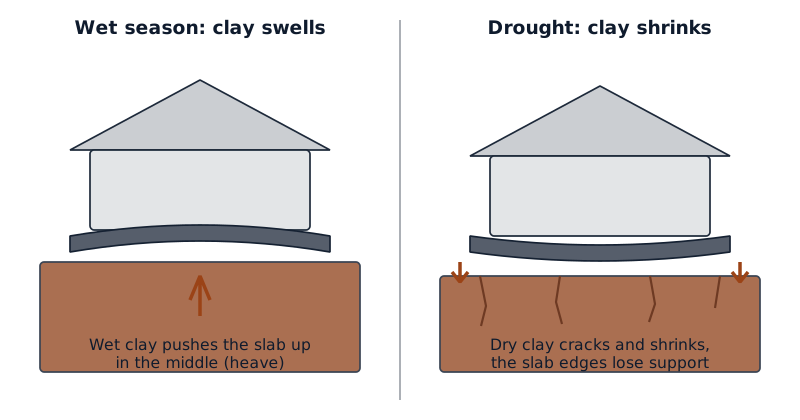
A Houston slab usually fails because the clay under it changes volume with the weather. The USDA describes the Lake Charles clay, typed in Fort Bend County, as 45 to 60% clay that cracks up to about 2 inches wide and a foot or more deep when dry. Clay that shrinks in drought and swells after rain leaves parts of a slab unsupported, and the concrete bends and cracks.
The soil is not the only cause:
- Uneven moisture. A gutter dumping at one corner or a large tree drawing water from one side makes part of the slab move more than the rest.
- Subsidence. The Harris-Galveston Subsidence District's 2025 report puts the fastest measured sinking, over 3 cm a year, in the Katy and Fulshear area, so slab owners in Katy have more than clay to think about. USGS recorded more than 10 feet of subsidence near Pasadena between 1906 and 1995.
- Heave. Wet clay can push the middle of a slab up. A heaved slab needs a different repair from a settled one.
The Lake Charles clay is common across Fort Bend County, including much of Sugar Land.
Which slab foundation repair methods are used?
The method depends on what the slab is doing. Settling at the edges or corners is usually fixed with piers. Hollow spots under a slab can be filled with grout or foam. Cracks in a slab that has stopped moving can be sealed with epoxy or a flexible filler. A contractor should explain why one method fits your house rather than offering the same fix for every job.
| Method | What it does | When it fits |
|---|---|---|
| Pressed concrete pilings | Concrete cylinders stacked and pressed down with a hydraulic jack | The usual fix for a settled Houston slab |
| Steel push piers | Steel pipe driven down against the weight of the house | Where firm soil is deeper |
| Helical piers | Steel shafts with screw plates turned into the ground | Lighter loads, tight access |
| Drilled bell-bottom piers | Drilled holes filled with reinforced concrete, wider at the base | Jobs an engineer specifies |
| Mudjacking or foam injection | Slurry or foam pumped under the slab | Voids, driveways, patios, small lifts |
| Crack sealing or epoxy injection | Seals cracks in stable concrete | Cracks with no ongoing movement |
There is more on each in the guides to foundation piers, polyjacking vs mudjacking and epoxy injection for foundation cracks. Products like epoxy and foam each have a narrow job, and none fixes a slab that is still moving.
How much does concrete slab foundation repair cost?
Most Houston foundation repair jobs cost about $3,300 to $6,800, according to the 2026 Houston Press guide. A slab with a few settled corners sits at the low end. A whole side of a house on piers, or a slab that needs interior piers through the floor, costs more. Sealing a crack in a stable slab can cost far less, often a few hundred dollars.
| Work | Typical range | Source |
|---|---|---|
| Typical Houston foundation repair job | $3,300 to $6,800 | Houston guide, 2026 |
| Concrete pier, each (Houston) | $300 to $600 | Houston guide, 2026 |
| Steel pier, each (Houston) | $1,000 and up | Houston guide, 2026 |
| Crack filling | $250 to $800 | National guide, 2026 |
| Mudjacking or slabjacking | $550 to $1,300 | National guide, 2026 |
| Foundation inspection (Houston) | $300 to $1,000 | Houston guide, 2026 |
| Structural engineer report | $500 to $1,000 | National guide, 2026 |
Interior piers add about 15% and access problems 6 to 8% on pier costs, per the Houston guide. These are guides; the contractor who visits writes the real price. For more detail, see slab foundation repair cost in Houston and the wider foundation repair cost guide.
Can deteriorating concrete be repaired?
Yes, in most cases. Deteriorating concrete that is cracked, scaling or flaking at the surface can usually be cleaned back to sound material and patched or sealed. What decides it is whether the slab underneath is still structurally sound and supported. Crumbling concrete with rusting steel showing through is a bigger job, and a structural engineer should look at it before anyone patches over it.
A slab cracking because the ground moves is a foundation problem, and a patch alone won't last. A crack that keeps growing, or with one side higher than the other, points to movement. The guide to structural engineer foundation inspections explains when an independent opinion is worth paying for.
What happens to the plumbing and air ducts under the slab?
Many Houston slab homes have drain lines, and some have air ducts, running under the concrete. Lifting a slab can stress old pipes, and a leak under the slab can itself cause the movement. That is why a plumbing test before and after the lift is commonly recommended. Collapsed or flooded in-slab ducts are a separate repair.
- Damp floors or a rising water bill. See the slab leak symptoms.
- Water after storms. Usually drainage, not a pipe. See water coming up through the slab after rain.
- Weak or musty airflow from floor vents. See repairing air ducts in a slab foundation.
Ask in writing who pays if a pipe breaks during the lift.
How do you choose a slab foundation repair company?
Choose a company that measures your slab before quoting, explains why the piers go where they do, and puts the pier count, pier type, permit and warranty in writing. Get a second opinion on a large job, and be wary of a price given before anyone measured the floor.
Ask any concrete slab foundation repair company how many piers, of what type; who pulls the permit; and what the warranty covers. Many cover the piers only, not plumbing or drainage.
When you send an enquiry through our quote request page, we'll arrange a visit from a local foundation contractor who measures the slab and gives you a written price before any work starts.
Questions people ask
How long does slab foundation repair take?
A pier job on a typical house often takes a few days of work on site, depending on how many piers go in and whether any are inside. A small crack repair may take an afternoon. Mudjacking slurry needs about 24 to 72 hours to cure, according to the Houston guide. Permits and any engineer's report add time before the work starts, so ask for the full timeline when you get the quote.
Do I need to be home during the repair?
Not for all of it. Most piers go in from outside, so you can usually stay in the house while the work goes on. Someone should be there when interior piers mean breaking through the floor, for the plumbing test, and at the end to check doors and floors. Clear furniture away from interior pier spots first.
Can I fix my slab foundation myself?
You can seal small, stable cracks in a concrete slab yourself with a filler or epoxy kit. Lifting a house onto piers is different: it needs hydraulic equipment, a pier plan, and in the City of Houston a building permit. A DIY lift can crack plumbing and drywall, so for anything more, have the slab measured first.
Is a slab foundation worse than pier and beam in Houston?
Neither is simply worse. A concrete slab has no crawl space to rot, but repairs mean digging and sometimes breaking the floor. Pier and beam is easier to adjust, but old shims and wood fail. Houston homes rarely have a basement. The comparison of concrete slab vs pier and beam covers it in more depth.
Read on
- Air ducts in a slab
How damaged or collapsed air ducts inside a concrete slab are repaired: the signs, the materials, rerouting vs relining, and what a…
- Costs
What slab foundation repair costs in Houston in 2026: prices by method, what pushes a concrete slab job up or down, and the extra costs to…
- Water through slab after rain
Why water seeps up through a Houston concrete slab after a storm, how to find where it gets in, what you can fix yourself, and when the…
See foundation repair houston for the other services and what they cost.
Sources
- Houston Press, guide to foundation repair in Houston (2026)
- This Old House, foundation repair cost guide (October 2026)
- USDA NRCS, Lake Charles soil series description
- USDA NRCS, Beaumont soil series description
- Harris-Galveston Subsidence District, 2025 annual groundwater report summary
- USGS Fact Sheet 110-02, land subsidence in the Houston-Galveston region
- City of Houston weekly building permit report, July 2024
Last changed