A sliding glass door usually sticks because grit has packed into the bottom track or the rollers under the panel are dirty, worn or set too low. Cleaning the track and adjusting the rollers fixes most of them in under an hour. When a clean, well-adjusted door still rubs at the top or leaves a tapered gap at the latch, the opening has probably racked out of square, and in Houston that often means the foundation has moved. This guide is the slider-specific part of why doors stick and when it matters: the order to check things, the repair steps, and the measurements that tell you to stop.
Why is my sliding glass door sticking?
Most sliding glass doors stick for one of four reasons: debris in the bottom track, dirty or worn rollers, rollers adjusted so low the panel drags, or a frame that has shifted. This Old House quotes a lumber yard specialist who says mud, food and hair get ground onto the track. Unlike a wood door, the glass panel does not swell in humid weather, so the cause is almost always mechanical or structural.
| What you notice | Most likely cause | Where to start |
|---|---|---|
| Gritty, grinding feel along the bottom | Debris in the track | Vacuum and wipe the track |
| Door feels heavy all the way across | Rollers dirty, flat or seized | Clean or replace the rollers |
| Bottom edge scrapes the sill | Rollers set too low | Raise the rollers |
| Panel rubs the top track or head | Rollers set too high, or the head has dropped | Lower the rollers, then check the head |
| Gap at the latch is wider at top than bottom | Opening out of square | Measure the opening |
| Lock no longer reaches its keeper | Panel or frame has shifted | Adjust the rollers, then measure |
Work down the table in order. The first three are cheap and quick. The last three are where a door problem can become a house problem.
How do you fix a sliding glass door that sticks?
Clean first, adjust second, replace parts third. Vacuum the bottom track, scrape off hardened buildup, and wipe it with a rag dampened with denatured alcohol. Then find the roller adjustment screws low on the panel and set the door so the gap along its top and bottom edges is even. If the rollers are cracked, flat or will not spin, replace them with ones that match the door.
The steps, based on This Old House's repair guides:
- Vacuum the bottom track. Get into the corners and the weep slots. Scrape stubborn deposits with a putty knife.
- Wipe it down. A rag with denatured alcohol lifts grime that a damp cloth leaves behind.
- Find the adjustment screws. They are usually at the bottom of the panel, on the edge facing the jamb, sometimes under a small plug.
- Adjust in small turns. On most doors, turning the screw counterclockwise lowers that corner and clockwise raises it. Lift the panel slightly with a flat pry bar while you raise it. Slide the door after every turn.
- Aim for an even gap. The reveal along the top and bottom edges should be uniform from one end to the other.
- Pull the panel if the rollers are bad. Retract the rollers fully, remove any head stop, tilt the top of the panel toward you and lift it off the track. Do this with a second person: the glass panel is heavy.
- Clean or replace the rollers. Wipe the wheels with denatured alcohol. Pry damaged ones out of their pockets and tap matching new ones in.
- Lubricate sparingly. Use a silicone spray on the rollers. This Old House warns against oil-based or petroleum lubricants, which hold dust and leave a sticky film.
The same family of hinge, strike and paint fixes for ordinary swinging doors is on how to fix sticking doors.
How can you tell a track problem from a foundation problem?
After cleaning and adjusting, slide the door and watch where it binds. A track or roller problem drags evenly along the bottom. A foundation problem shows as uneven gaps: the panel rubs the head at one end, the latch gap tapers, or the lock misses its keeper. If adjusting the rollers fixes it and it stays fixed, the house is probably fine.
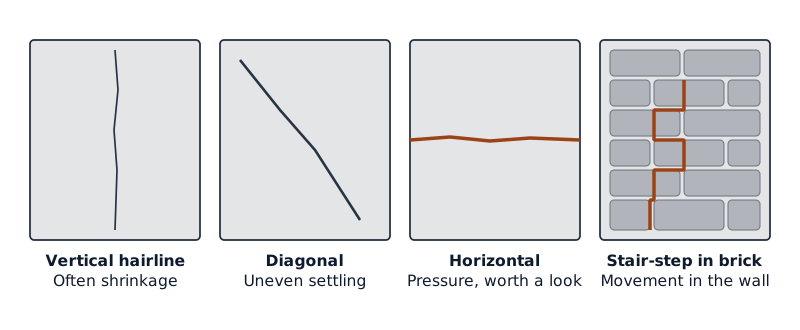
Three checks you can do with a tape measure and a level:
- Measure the diagonals. Close the door. Measure the frame opening from top left to bottom right, then top right to bottom left. A square opening gives two equal numbers. Write them down with the date.
- Watch the latch gap. Look at the gap between the panel's lock edge and the jamb. A gap that is wider at the top than the bottom, or the other way, means the frame is leaning.
- Check the sill. Lay a level along the bottom track. A slope from one end to the other is worth noting, because the track sits on the slab or floor framing.
One reading tells you little. Measure again in a month or two, after a dry spell or heavy rain. Numbers that keep moving point to the structure, not the door.
Why are the doors in my house suddenly sticking?
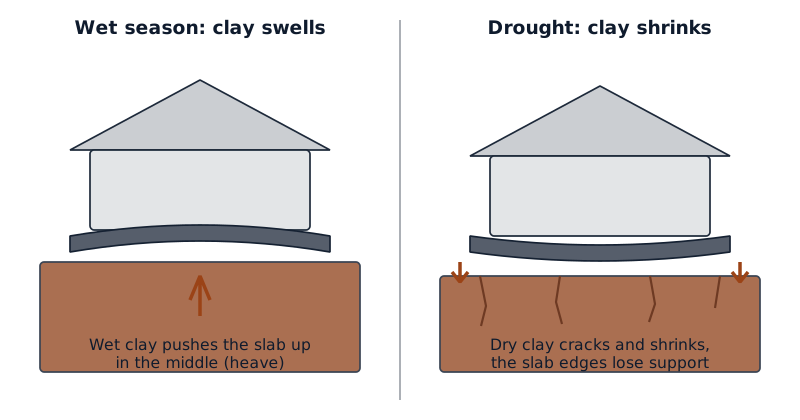
When several doors start sticking at about the same time, the house is usually telling you something changed underneath it. In Houston the common trigger is the weather: a long dry spell lets the clay under the slab shrink, or a wet stretch lets it swell, and part of the foundation moves. One door sticking is usually the door. Several at once is usually the house.
The USDA soil survey describes the Lake Charles clay, typed in Fort Bend County and common across the region, as 45 to 60% clay. When it dries it opens cracks half an inch to two inches wide and a foot or more deep, and in most years those cracks stay open 60 to 90 days in total. Ground that shrinks and swells that much does not move evenly under a house.
Patterns that make a sudden change more likely to be structural:
- Doors and windows on the same side of the house changed together
- A slider that ran fine for years began binding over a few weeks
- New cracks appeared near the same openings
- The change followed a drought, a flood or a plumbing leak
The broader checklist of warning signs, inside and out, is on signs of foundation problems.
Does foundation settling crack drywall around doors and windows?
Yes. Foundation settling often shows first as cracks in drywall at the corners of door and window openings, because those corners concentrate stress when the framing shifts. Look for diagonal cracks running up from the top corners of the slider's frame, tape seams that split above it, and gaps where the wall meets the ceiling. Fresh cracks plus a sticking slider are a stronger signal than either alone.
Small hairline cracks in drywall are common and not always structural. What matters is direction, width and whether they grow. Mark the end of a crack with a pencil and the date, and check it again in a few weeks. A crack that runs past your mark, or reopens after it has been patched, is moving.
How drywall cracks from ordinary settling differ from ones that need attention is covered on drywall cracks from settling.
When does a sticking patio door need a foundation contractor?
Call a foundation contractor when the slider still binds after the track is clean and the rollers are set, when the opening's diagonals keep changing, or when the door sticks alongside new cracks and sloping floors. At that point the door is a symptom. Planing, shimming or forcing the rollers higher only hides the movement until it shows up somewhere else.
A foundation inspection in Houston typically costs $300 to $1,000, with an average around $600, according to a 2026 Houston Press guide. The visit usually includes a walk around the outside, a look at the slab or crawl space, and a floor elevation survey that shows which parts of the house sit high or low. That survey is what links a sticking slider to the part of the foundation underneath it.
This is also where DIY stops. Lifting a house is structural work, and inside the City of Houston foundation repair needs a building permit; the city's weekly permit reports list residential foundation repairs, including shim and level work. Slab homes are usually lifted with piers, covered on foundation leveling. Older homes on piers, common in neighborhoods like the Heights, are often reset or shimmed from the crawl space, covered on pier-and-beam foundation repair.
After any lift, expect the slider to need its rollers readjusted, since the opening has changed shape again.
If your slider and other doors started binding together, we'll arrange a visit from a local foundation contractor, and you get a written estimate with the price before any work starts.
Questions people ask
How long does it take to fix a sticking sliding glass door?
Cleaning the track and adjusting the rollers usually takes under an hour. Replacing the rollers takes longer, because the panel has to come out, and you need a second person to lift it. If the cause turns out to be foundation movement, the door fix waits until the house is stabilized and leveled, then the rollers are set again.
Should I use WD-40 or another oil on a sliding door track?
No. Oil-based and petroleum lubricants attract dust and leave a sticky residue that makes the problem worse. Clean the track instead, and use a small amount of silicone spray on the rollers. A clean, dry track with free-spinning rollers slides better than a greasy one.
Can a sliding glass door stick because of humidity?
Rarely. The glass and the aluminum or vinyl frame do not swell the way a wood door does. A wood-framed slider can tighten slightly in humid months, but if a modern slider sticks more in one season than another, look at the soil under the house. Clay that shrinks in dry months and swells after rain can shift the opening.
What should I ask before I hire someone about a sticking slider?
Ask whether they will check the track and rollers or the foundation, because those are different trades. For a foundation visit, ask whether it includes a floor elevation survey, whether the estimate comes in writing, and who pulls the building permit if repair is needed. Ask what door adjustments after leveling are included.
Do I need to be home for a foundation inspection?
It helps. You know which doors and windows changed, when they changed, and what the weather was doing. Have your diagonal measurements, crack marks and photos ready. The inspector needs access to every room and, on a pier-and-beam house, to the crawl space, so plan to be there or arrange access in advance.
This guide is one of many on foundation repair houston.
Sources
- This Old House, how to repair your sliding door
- This Old House, how to adjust your sliding door
- USDA NRCS, Lake Charles soil series description
- City of Houston weekly building permit report, July 2024
- Houston Press, guide to foundation repair in Houston (2026)
- Houston Heights design guidelines, City of Houston Planning
Last changed