The most common signs of foundation problems are doors and windows that suddenly stick or won't latch, cracks that run diagonally from the corners of doors and windows, floors that slope or feel bouncy, and gaps where walls meet ceilings or floors. Outside, look for stair-step cracks in brick, a slab edge that has cracked or dropped, and gaps around window frames. One sign on its own often means little. Several together, getting worse over weeks, usually indicate movement. Sticking doors are covered in depth on our guide to doors sticking and when to worry. This page lists the interior and exterior warning signs, which are normal, and what to do next.
What are the first signs of foundation problems?
The first signs are usually small changes in how the house works rather than big cracks. A door that used to close easily starts to rub at the top corner. A window sash binds. A thin crack appears above a door frame, angled toward the ceiling. Caulk joints around tubs, counters and trim pull apart. These early signs show before most visible damage, because doors and windows have tight clearances that react to small shifts.
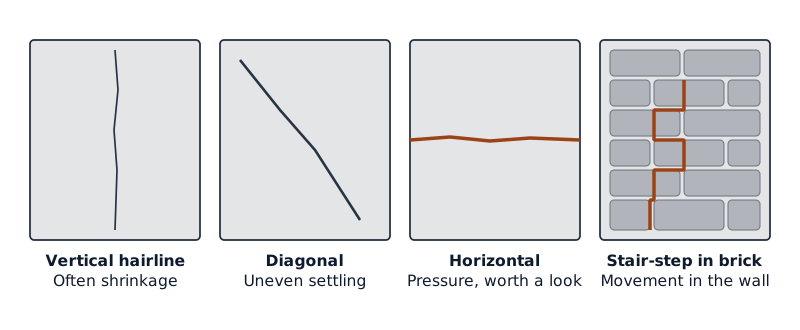
Keep a simple record once you notice one. Date it, photograph it next to a coin or ruler, and pencil a mark at each end of any crack. If the crack grows past the mark or more doors start sticking within a few months, the movement is active. If nothing changes through a full wet and dry season, it may be old movement that has stopped.
What are the interior signs of foundation problems?
Inside a house, the warning signs cluster around openings and joints. Doors that stick, swing open on their own or leave a wedge-shaped gap at the top. Windows that are hard to open or lock. Diagonal drywall cracks from the corners of doors and windows. Floors that slope, crack tile or separate from baseboards. Gaps between walls and the ceiling, and cabinets or counters pulling away from the wall.
| Interior sign | What it can indicate | How seriously to take it |
|---|---|---|
| Hairline crack in drywall seam, not growing | Normal shrinkage of framing and drywall | Low; patch and watch |
| Diagonal crack from a door or window corner | Frame racked by movement below | Medium; mark and measure |
| Several doors sticking at once | Floor or slab out of level | Medium to high |
| Floor slope you can feel, or cracked floor tile in a line | Slab or beam deflection | High; have it measured |
| Gap between wall and ceiling or floor | Wall dropping or lifting | High |
| Water on a slab floor with no plumbing leak above | Possible slab leak or drainage issue | High; see slab leak symptoms |
On a pier-and-beam house, the interior signs are often softer: bouncy or sagging floors, a dip in the middle of a room, or a floor that falls toward one wall. Those point to the piers, shims or beams in the crawl space rather than a cracked slab. The repair options for that kind of house are on pier and beam foundation repair.
What are the exterior signs of foundation problems?
Outside, walk the full perimeter in daylight. Look for stair-step cracks in brick veneer, cracks in the exposed slab edge, mortar falling out, and brick pulling away from window and door frames. Check whether the gap under the bottom row of brick has widened, whether the chimney leans, and whether soil has pulled away from the slab in dry weather. Water pooling against the foundation after rain is a cause worth fixing too.
The type of crack matters. A thin vertical crack in a slab edge is common and often harmless. A horizontal crack, or a crack wider at one end than the other, says more about which way the foundation has moved. The differences are laid out in vertical vs horizontal foundation cracks. Trim and fascia boards that have separated at the corners are another clue, because the roof line stays straight while the walls below shift.
Which signs are normal settling and which mean a real problem?
Normal settling produces thin, stable cracks, often in drywall seams or a slab, that don't grow and don't come with sticking doors or sloping floors. A real problem shows as cracks that widen, run diagonally or in stair steps, or come in groups with doors and windows that bind. Width, direction, growth over time and the number of signs together tell you more than any single crack.
As a rough guide, a crack you can't fit a coin edge into, that stays the same for months, is rarely structural. A crack you can slip a coin into, that is wider at one end, or that reappears after patching, needs a closer look. The full comparison is on foundation problems vs settling. When you can't tell, a foundation inspection with floor level readings settles it, because a contractor or engineer measures how far the slab has moved instead of guessing from cracks.
Why do Houston homes show these signs so often?
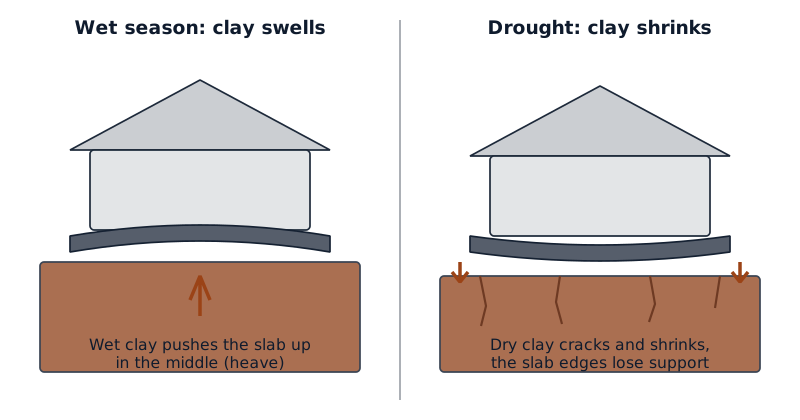
Houston homes show foundation signs often because most sit on clay that shrinks and swells with moisture. The USDA describes the Lake Charles clay, typed in Fort Bend County, as 45 to 60% clay, cracking half an inch to two inches wide and a foot or more deep when dry, with cracks open 60 to 90 days in most years. That seasonal movement lifts and drops a slab unevenly.
The Beaumont clay east of the Trinity River behaves in a similar way, and much of the region has also sunk as groundwater was pumped. The USGS measured more than 10 feet of subsidence near Pasadena between 1906 and 1995. That is why many Houston homeowners notice new signs after a long dry summer, or after a wet spell follows drought. Watering the soil evenly around the slab in dry months can reduce the swing; the method is on soaker hose for foundation.
How much does foundation repair cost once you see the signs?
Most Houston foundation repair jobs cost about $3,300 to $6,800, according to a 2026 Houston Press guide, with the number of piers driving most of the price. Pressed concrete piers run about $300 to $600 each and steel piers $1,000 or more. Sealing a single crack can cost $250 to $800 nationally, while a full lift for severe settling can reach $20,000 or more.
| Job | Typical range | Source |
|---|---|---|
| Foundation inspection | $300 to $1,000 | Houston guide, 2026 |
| Crack sealing | $250 to $800 | National guide, 2026 |
| Typical Houston repair | $3,300 to $6,800 | Houston guide, 2026 |
| Pressed concrete pier, each | $300 to $600 | Houston guide, 2026 |
| Lift and level for severe settling | $20,000 to $23,000 | National guide, 2026 |
This Old House notes that a hairline crack sealed early for a few hundred dollars can become a $10,000 to $15,000 repair if it's left to grow. These figures are a guide; the written quote sets the real price. The full breakdown is on foundation repair cost in Houston. Inside the City of Houston, foundation repair runs under a building permit, which the contractor normally pulls.
Is it worth fixing the foundation of a house?
Usually, yes, when the movement is active. A foundation that keeps moving keeps cracking drywall, brick, tile and sometimes plumbing under the slab, so each year of waiting adds repairs on top. Fixing it also matters when you sell, because buyers and their inspectors look for exactly these signs. If the signs are old and stable, monitoring and better drainage may be enough.
The test is whether the cost of the repair is small next to the value of the house and the damage it prevents. For a typical Houston home, a repair in the $3,300 to $6,800 range often is. For an older house with severe movement and other problems, get an engineer's report before you decide.
Questions people ask
Can you live in a house while foundation repair is done?
Yes, in most cases. Piers under the slab edge are installed from outside, so you can stay home, though it gets noisy while the hydraulic jacks run. Interior piers are different: the contractor cuts through the floor inside, which the Houston Press guide says adds about 15% to the cost. You may need to clear a room or two for a few days.
Will homeowners insurance pay for foundation repair?
Often not on a standard policy. The Texas Department of Insurance says most homeowners policies don't cover earth movement or wear and tear, which is how much soil-related foundation damage is classed. It lists damage to foundations or slabs as a common endorsement you can add. Read your policy's exclusions and ask your agent before you file a claim.
What time of year is best for foundation repair?
There's no single best season in Houston, and repairs run all year. What matters more is when the house is measured. Clay shrinks in dry months and swells after heavy rain, so a slab can read differently in August than in a wet spring. A good contractor allows for that when setting the lift, and many owners first notice signs after a dry summer.
Can you replace a foundation without lifting the house?
Generally, no. A full foundation replacement means supporting or lifting the house so the old slab or piers can come out, which is rare and very costly. Most Houston repairs don't replace anything. They add piers under the existing slab or reset the piers under a pier-and-beam house, then bring it back toward level, which is far cheaper.
What are the signs of foundation issues people mention on Reddit?
Homeowners posting online most often describe doors that won't latch, diagonal cracks above door frames, gaps between baseboards and tile, and brick cracks in a stair-step line. Those match the signs on this page. Photos in a forum thread can't show whether a crack is growing or how far a floor has dropped, so measurements on site are the only way to be sure.
This guide is one of many on Foundation Repairs Houston Quotes foundation repair.
Sources
- USDA NRCS, Lake Charles soil series description
- USDA NRCS, Beaumont soil series description
- USGS Fact Sheet 110-02, land subsidence in the Houston-Galveston region
- Houston Press, guide to foundation repair in Houston (2026)
- This Old House, foundation repair cost guide (October 2026)
- Texas Department of Insurance, homeowners insurance guide
- City of Houston weekly building permit report, July 2024
Last changed