To fix a crack in a drywall ceiling, open it into a shallow V, bed fiberglass mesh tape in joint compound, add two or three thin coats feathered well past the crack, then prime, retexture and paint. That holds when the crack came from shrinking lumber or a weak seam. It fails when the ceiling is still moving, which on Houston clay can mean the slab below has shifted. This guide covers the overhead repair step by step, how to match popcorn and knockdown texture, and which ceiling cracks to leave for a contractor. For cracks in the concrete itself, start with our foundation crack repair guide.
How do you fix a crack in a drywall ceiling?
Fix a drywall ceiling crack by cutting it open slightly, cleaning out loose gypsum, pressing joint compound in, and covering it with mesh tape before skim coats. Work in thin layers, because thick compound sags and cracks overhead. Feather each coat a few inches wider than the last, sand lightly between coats, then prime before you texture or paint. Expect a weekend, mostly spent waiting for coats to dry.
- Set up safely. Use a stable ladder you move along the crack rather than leaning out. Cover the floor and wear eye protection, since dust falls straight down.
- Check the ceiling first. Push gently either side of the crack with a flat hand. If the board gives, bows or feels soft, stop here and read the section on when to call a professional.
- Open the crack. Use a utility knife or a hooked scraper to cut a shallow V along it, removing anything loose. Cut out any lifted tape.
- Clean it. Brush out the dust so the compound bonds to solid gypsum.
- Fill and tape. Mix compound a little stiffer than you would for a wall so it stays put. Press it into the V, then bed mesh tape over the crack. This Old House recommends fiberglass mesh tape for cracks because moisture does not affect it.
- Skim in thin coats. Apply two or three coats, each wider than the last, letting each dry fully. Sand lightly between coats.
- Prime, texture, paint. Prime the dry patch so the texture and paint take evenly, then match the texture and paint the whole ceiling panel, corner to corner, so the patch does not show.
Which compound to choose is covered in our guide to filler for cracks in walls.
What causes cracks in a drywall ceiling?
Most ceiling cracks come from the framing above: seams opening as lumber dries, fasteners loosening, or roof framing lifting off interior walls. Moisture from a roof or attic leak causes another group. A smaller number come from the house below moving, which in Houston usually means the slab or the piers shifting with the clay. The shape and position of the crack point to which cause you have.
| What you see on the ceiling | The likely cause | What to do |
|---|---|---|
| Straight hairline cracks along a seam | Joint tape lifting as framing dries | Cut out loose tape and re-tape |
| Gap where the ceiling meets an interior wall | Roof framing lifting or settling | Float the joint or add trim, do not fill rigidly |
| Crack with a brown ring or stain around it | Water from the roof, attic or plumbing | Find and stop the leak before any repair |
| Cracks spreading in a web from one spot, with a dip | Board sagging, often from water or loose fasteners | Stop and have it looked at |
| Crack running from a wall across the ceiling, widening | Movement in the walls below, sometimes the foundation | Check the foundation signs below first |
| Fine cracks on an older textured ceiling | Texture shrinking or the paint film aging | Leave alone or skim, with care over asbestos |
Building Science Corporation explains the interior wall gap: when the top and bottom of a roof truss hold different amounts of moisture, the truss arches and lifts the ceiling. Its report describes insulated attics with a warm bottom chord and a cold top chord, so in a Houston attic treat it as one possibility, not the answer.
How do you match the texture on a cracked ceiling?
Match a ceiling texture by identifying it first, then practicing on scrap board before touching the ceiling. Orange peel and knockdown can be sprayed from an aerosol can or a hopper, and knockdown is flattened with a wide knife once it starts to set. Popcorn texture comes in spray cans and patch tubs.
Before you scrape or sand any older textured ceiling, think about asbestos. The US Environmental Protection Agency lists textured paint and patching compounds used on walls and ceilings among the places asbestos may be found. The EPA's advice is to leave material that may contain it undisturbed, and to have a trained, accredited professional take samples, because sampling done wrongly can be more hazardous than leaving it. If you do not know what an older texture contains, have it tested before sanding.
Why does a ceiling crack keep coming back after you fix it?
A ceiling crack comes back because whatever opened it is still moving. Compound and tape are rigid, so they cannot stretch with a truss lifting each season or a wall frame being racked from below. A crack that reopens once, in the first year or two of a new house, is often lumber still drying. One that reopens every season, or wider each time, needs its cause found.
For the ceiling-to-wall gap, the fix is to let the joint move. Building Science Corporation recommends floating corners: ceiling board left unfastened near the top of interior walls (their drawing shows 18 inches clear) or held on clips, so the board bends instead of cracking. A trim molding fixed to the ceiling only hides the gap and moves with it.
If the crack follows movement in the walls below, no ceiling repair will last.
When is a ceiling crack a sign of a foundation problem?
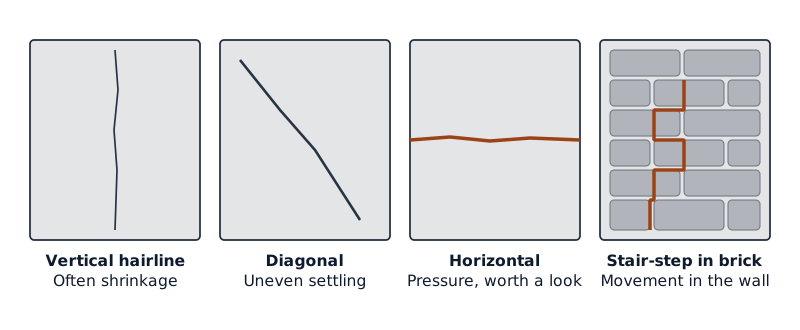
A ceiling crack points to the foundation when it lines up with other movement: diagonal cracks above doors on the same side of the house, doors that start to rub, floors that slope, or brick cracks outside. Cracks that run from the top of a wall across the ceiling, and widen over months, are the serious kind. A single hairline crack on a seam almost never is.
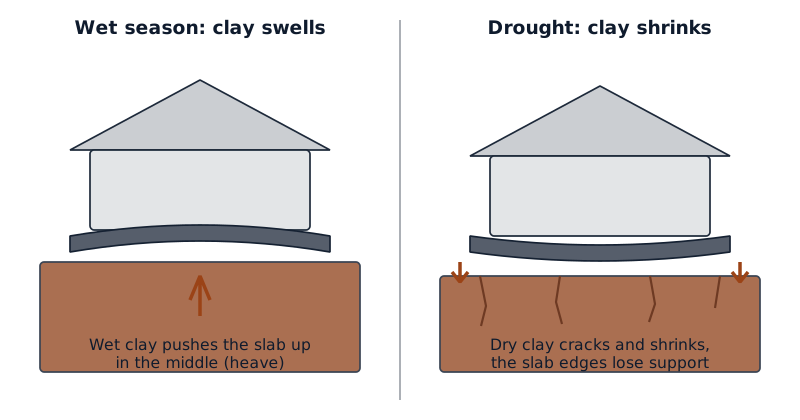
Houston has a local reason for this. Much of the area sits on Lake Charles clay, which USDA soil scientists describe as mostly clay that opens cracks up to 2 inches wide at the surface in dry weather. When one side of the house dries out faster than the other, that side of the slab can drop, and the frame above it twists. Ceiling cracks from that kind of movement usually come with wall and door symptoms, so check those too.
Check the room below the crack:
- Do nearby doors close and latch cleanly? Our page on doors sticking explains how to read the gaps.
- Does a level or a marble show the floor sloping toward one wall?
- Are there diagonal cracks at the corners of doors and windows in the same area? See cracks in sheetrock walls for what each wall pattern means.
Advice about horizontal cracks in basement walls applies where soil presses on a wall, and Houston homes almost never have a basement. Here, the questions are about the slab and the piers. The full list of symptoms is in our guide to signs of foundation problems.
When should you stop and call a professional?
Stop and get help when the ceiling sags, feels soft, or shows a fresh water stain, because wet gypsum loses strength and can come down. Call a roofer or plumber for a leak, a drywall finisher for a large or textured repair, and a local foundation contractor when ceiling cracks come with sticking doors, sloping floors or wall cracks that keep widening.
For a stain, find the water first: the roof, an attic fitting or a plumbing line above. Patching wet board traps the damp, and waterproofing the slab does nothing for water from above.
For movement, the first step is a foundation inspection with floor elevation readings. The Houston Press puts Houston foundation inspections at about $300 to $1,000, and most foundation repair jobs at $3,300 to $6,800. Inside the City of Houston, foundation repair needs a building permit, which the contractor normally arranges. Repair the ceiling after any foundation work, since lifting a slab can open new cracks.
If you want the house checked, we'll arrange a visit from a local foundation contractor, and you get a written quote before any work starts.
Questions people ask
Are cracks in a drywall ceiling serious?
Most are not. Hairline cracks along taped seams and small gaps at the ceiling line are common and cosmetic. A ceiling crack is serious when the board sags or feels soft, when there is a water stain, or when the crack widens over months alongside sticking doors and sloping floors.
Can I just paint over a hairline crack in the ceiling?
You can, but it usually shows again within a season. Paint has almost no strength across a crack, so any small movement reopens the line. For a lasting repair, open the crack, bed mesh tape in compound, skim it, prime and paint. An old, stable hairline can also just be left.
How long does it take to fix a crack in a drywall ceiling?
Plan on two or three days for a typical crack, though the hands-on work is only an hour or two. Each coat of compound has to dry fully before the next, and primer, texture and paint each need their own drying time. Quick-setting compounds mixed from powder often shorten the wait between coats.
Does moisture in the attic cause ceiling cracks?
It can. Moisture differences between the top and bottom of roof trusses are the cause of truss uplift, which lifts the ceiling off interior walls. A slow leak from the roof or an attic fitting causes a different crack, usually with a stain, as the wet gypsum softens. Check the attic above any stained crack before you repair the ceiling.
This guide is one of many on the foundation repair guide for Houston.
Sources
- This Old House, how to patch cracked drywall
- Building Science Corporation, RR-0107 Drywall, Wood and Truss Uplift (2001)
- US Environmental Protection Agency, learn about asbestos
- US Environmental Protection Agency, protect your family from exposures to asbestos
- USDA NRCS, Lake Charles soil series description
- Houston Press, guide to foundation repair in Houston (2026)
- City of Houston weekly building permit report, July 2024
Last changed