Walk away from foundation issues when you can't get a clear answer to three questions before your deadline: why the house moved, whether a repair will stop it, and what that repair really costs. A sticking door or a hairline crack on a Houston slab is rarely a reason to leave. Active movement nobody can explain, a seller who blocks testing, a repair that failed once already, or a cost the deal can't absorb usually is. This guide, part of our wider page on foundation repair in Houston, focuses on the decision itself: the deal-breakers, the cost test, the Texas deadline that decides whether you keep your earnest money, and when an owner should stop paying for repairs.
When should you walk away from foundation issues?
Walk away when the risk can't be priced. If an engineer can't name the cause of the movement, the seller won't allow a slab leak test, records of an earlier repair are missing, or the written quote is more than the price cut or credit on offer, the deal is carrying an unknown. Problems with a diagnosis and a fixed price can be negotiated. Unknowns can't.
The general case for buying a Houston house with a known, quoted repair is covered in buying a house with foundation issues. This page is about the other side of that line: the point where negotiating stops making sense.
You aren't deciding whether the foundation is perfect. Much of the area sits on clays such as the Lake Charles series, which the USDA describes as 45 to 60% clay, so some movement is normal here. You're deciding whether the movement has a known cause, a trusted fix and a written cost.
Which foundation problems are real deal-breakers?
The deal-breakers are signs of uncontrolled or unexplained movement, not signs of age. Fresh cracks that reopen after patching, floors that keep dropping between two measurements, piers from an earlier repair that have already failed, a suspected slab leak the seller won't let you test, and a house sitting on a known fault line are all reasons to step back. Cosmetic cracks and old, stable settlement usually aren't.
| What you find | Usually negotiate | Usually walk away |
|---|---|---|
| Hairline cracks in drywall or brick, no fresh edges | Yes | |
| Doors that stick in summer and free up in winter | Yes | |
| Engineer measures movement within normal limits, gives a clear repair plan | Yes | |
| Floors still dropping, cause unknown after an engineer's visit | Yes | |
| Earlier pier repair with no paperwork, no permit, no warranty | Often | |
| Earlier repair that has already moved again | Yes | |
| Seller refuses a plumbing test when a leak is suspected | Yes | |
| House on or beside an active surface fault | Often |
The difference between ordinary settling and movement that keeps going is explained in foundation problems vs settling. If a leak under the slab is the worry, the signs are listed in slab leak symptoms.
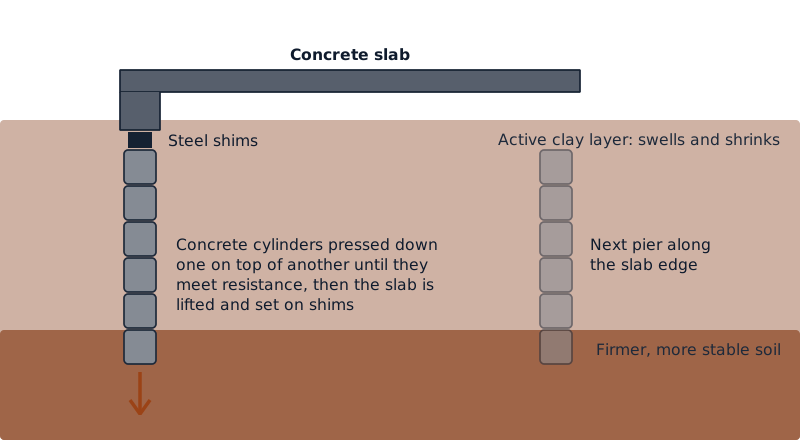
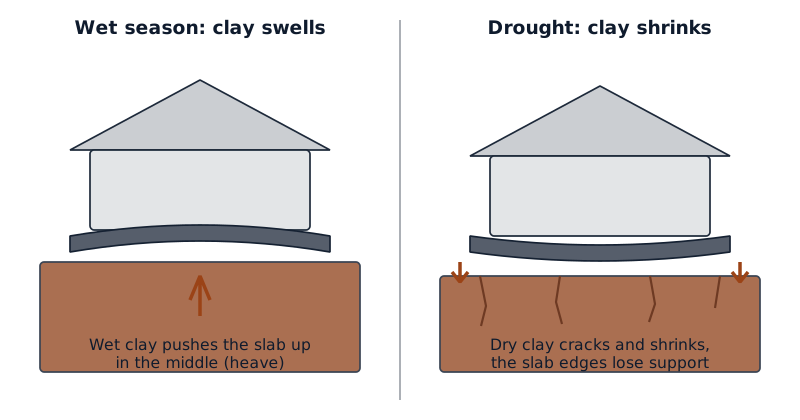
Water runs through most of these. A slab kept wet on one side by a leak, a downspout or ponding keeps that clay swelling while the rest dries, so until the water is stopped, no pier plan can stabilize the house for long.
How do you know if the repair cost is too high to stay in the deal?
The cost is too high when the written quote, plus the engineer's report, the permit and any drainage work, is more than the seller will take off the price or credit at closing. If you would have to pay the gap from your own savings after buying, and you weren't planning to, that gap is the real cost of staying. Compare totals, not the headline repair number.
Published guides give a sense of scale:
| Item | Typical range | Source |
|---|---|---|
| Most Houston repair jobs | $3,300 to $6,800 | Houston guide, 2026 |
| Foundation inspection in Houston | $300 to $1,000 | Houston guide, 2026 |
| Structural engineer report | $500 to $1,000 | National guide, 2026 |
| Permit | $75 to $150 | National guide, 2026 |
| Severe lifting and leveling | $20,000 to $23,000 | National guide, 2026 |
Interior piers, cut through the slab indoors, add about 15% according to the Houston Press guide and often mean lifting finished floors. A slab leak found in testing adds plumbing work first. Price ranges for each repair method are on foundation repair cost in Houston.
When is the last moment to walk away without losing your earnest money in Texas?
On a standard Texas resale contract, the last safe moment is the end of your option period: notice of termination must reach the seller by 5:00 p.m. local time on the last day. If you terminate in time, your earnest money is refunded and the seller keeps the option fee. Miss that deadline and you lose the unrestricted right to walk away.
The TREC resale contract (TREC No. 20-19) gives the buyer an unrestricted right to terminate during the option period, for any reason, as long as the option fee was paid on time. It says time is of the essence and that strict compliance with the deadline is required. There is no grace period for a report that arrives late.
Plan backward from it:
- Book the home inspection the day the contract is signed.
- If the inspector notes movement, book a structural engineer the same day, not after you read the full report.
- Ask for repair quotes based on the engineer's findings while the engineer is still writing up.
- Decide at least a day before the option period ends, so there's time to send the notice.
Can a flood history or a fault line be a reason to walk away in Houston?
Yes, both can. A house in a mapped flood zone that needs major work can trigger floodplain rules that make the repair far bigger than the foundation itself. A house built across an active surface fault can keep moving whatever the piers do.
Flood zones. FEMA's 50% rule applies in a Special Flood Hazard Area. If the cost to repair a building reaches 50% or more of the building's market value (land not counted), or proposed improvement work reaches that level, local officials can rule it substantial damage or substantial improvement. The building then must be brought up to current floodplain standards, which for many homes means elevation. Your city's floodplain administrator makes that call, not FEMA. In flood-hit areas like Meyerland, ask about the house's flood and repair history before you price any foundation work.
Faults. USGS work on the Houston region records houses damaged by fault creep, and a University of Houston study warns that faults in Katy and The Woodlands will likely reactivate if groundwater pumping trends continue. Piers support the slab, but they generally can't stop the ground on either side of a fault from shifting. The TREC Seller's Disclosure Notice asks about settling, soil movement and fault lines, so read that answer, and if a crack pattern runs in a straight line across the lot and the street, ask the engineer about it directly.
Should you walk away from a house you already own with foundation problems?
Sometimes, but rarely as a first move. If one engineered repair, plus a drainage fix, can stabilize the house, repairing is usually cheaper than selling at a discount. Selling as is starts to make sense when repairs have failed more than once, when floodplain rules would force a much larger project, or when the total cost is out of proportion to what the house is worth.
Questions to ask yourself before you list as is:
- Has a structural engineer seen it? One contractor's quote isn't a diagnosis. An engineer's report tells you, and any buyer, what is needed.
- Has the water problem been fixed? Gutters, grading and leaks are often a fraction of the repair cost and stop the cause.
- Have repairs already failed? A second failure of the same repair method is a stronger signal than a large first quote.
- Will a buyer discount the house more than the repair costs? Buyers tend to discount the unknown heavily, so a finished, permitted repair can be worth more at sale than it cost.
Selling as is doesn't skip disclosure: TREC says its notice is required of sellers of previously occupied single family homes, and it asks about previous structural repair.
What should you do before you decide to walk away?
Get the facts in the right order, so the decision rests on measurements, not a single inspection note. An engineer's floor elevations, a plumbing test if a leak is suspected, at least one written repair quote, and the seller's paperwork on any past repair give you everything you need. With those four in hand, the choice between negotiating and walking away usually becomes clear.
- Measure. A structural engineer takes floor elevations across the house and says whether movement looks active. See what a structural engineer does in a foundation repair.
- Test for water. If the engineer suspects a leak, request the seller's written permission for a plumbing test, as the TREC contract requires for hydrostatic testing.
- Price it. Ask a foundation contractor to quote from the engineer's plan, with the repair method, number of piers, permit and warranty spelled out.
- Check the history. Ask for past repair invoices, pier logs, permits and warranty transfer terms.
- Decide. Compare the total cost with the concession on offer, and send any termination notice before the deadline.
If you're inside your option period and need a firm number, request a written foundation quote. We'll arrange a visit from a local foundation contractor who looks at the house, explains the repair methods that fit, and puts the price in writing before any work is agreed.
Questions people ask
How long does foundation repair take?
The work on site is often the shorter part of the process. Getting an engineer's report, collecting quotes, pulling a City of Houston building permit and booking the contractor often take more time than the work. If you're buying, plan for that before your closing date rather than assuming the repair fits inside a week.
What should I ask before I hire someone for foundation repair?
Ask which repair method they recommend and why, how many piers and where, whether the plan follows an engineer's report, who pulls the permit, and what the warranty covers and whether it transfers to a new owner. Ask how they will handle plumbing found under the slab. Get every answer in the written quote, not just in conversation.
Do I need to be home for foundation repair?
Usually not for exterior pier work, as long as the contractor has access to the yard and utilities. You or someone you trust should be there for the first visit, for any interior work that means cutting through floors, and for the final walk-through. Agree access, pets and parking in advance so the work isn't delayed.
Is it a red flag if the seller already repaired the foundation?
Not by itself. A past repair with the engineer's report, a permit, a pier log and a transferable warranty can make a house a safer buy than one that has never been checked. The red flags are missing paperwork, a repair done without a permit, or signs that the house has moved again since the work.
Can I walk away after the option period ends?
Only if another part of your contract gives you a right to terminate, such as a financing addendum or another condition you agreed to. Under the standard TREC resale contract, the unrestricted right to terminate ends with the option period, and leaving later can put your earnest money at risk. Check with your agent or a real estate attorney first.
Sources
- Texas Real Estate Commission, One to Four Family Residential Contract (Resale), TREC No. 20-19
- FEMA, Substantial Damage Quick Guide
- Houston Press, guide to foundation repair in Houston (2026)
- This Old House, foundation repair cost guide (October 2026)
- USGS Fact Sheet 110-02, land subsidence in the Houston-Galveston region
- University of Houston, study on Houston subsidence and faults (2022)
- Texas Real Estate Commission, Seller's Disclosure Notice, TREC No. 55-1
- USDA NRCS, Lake Charles soil series description
Last changed