Plastic shrinkage cracks are short, shallow cracks that open in a concrete slab within the first few hours after the pour, while the concrete is still soft. The surface loses moisture to sun, heat and wind faster than water can rise from below, so the top skin shrinks and tears. They usually look alarming and rarely are: the slab still carries the house. This page covers how to recognize them, how they differ from movement cracks, how to seal them and how a new pour avoids them. For cracks of every kind, start with our guide to foundation crack repair in Houston.
What are plastic shrinkage cracks in a concrete slab?
They are cracks that form in fresh concrete before it hardens, during roughly the first few hours after placing, on flat surfaces open to the air. Penn State's concrete engineering library describes them as about 1/8 inch wide and typically 2 to 4 inches deep, sometimes running several feet, and often branching in a crow's-foot shape. They show up at the start of the slab's life, not years later.
"Plastic" means the concrete is still soft enough to shape with a trowel and has almost no strength, so a small pull at the surface splits it.
Because the crack forms before the stone and the cement paste bond, it tends to snake around the larger pieces of aggregate and follow the line of reinforcing bars just under the surface rather than cutting straight through stone.
What causes plastic shrinkage cracks?
They are caused by water leaving the top of the slab faster than it can be replaced. After a pour, solids settle and a film of bleed water rises to the surface. When evaporation outpaces that bleeding, the surface dries, shrinks and cracks while the concrete below is still wet. High air and concrete temperatures, low humidity, wind, and concrete much warmer than the air all speed evaporation.
Penn State's material puts numbers on it. Above an evaporation rate of 0.5 kg per square meter per hour, cracking is possible. Above 1.0 kg, roughly 0.2 pounds per square foot per hour, it is almost certain.
Houston's humid air helps on some days, but a sunny, breezy afternoon can still dry an open pad fast. Penn State also notes these cracks can form in cold weather when warm concrete meets much colder air.
How can you tell a plastic shrinkage crack from a settlement crack?
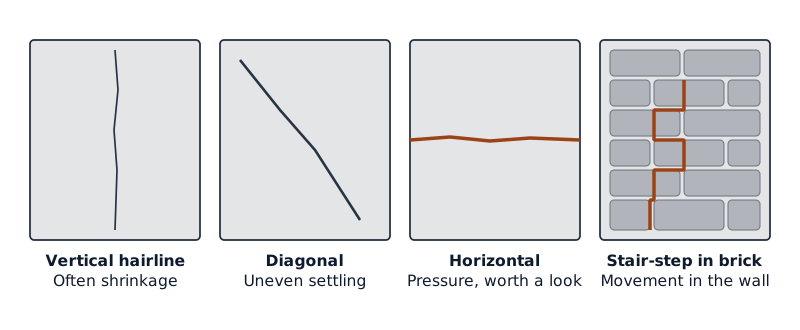
Look at when it appeared and what it does. A plastic shrinkage crack was there from the first days, is short and shallow, sits flat with both edges level, and does not grow. A settlement or heave crack tends to show up later, often runs to the slab edge, can widen through dry summers, and may leave one side higher than the other.
| What you see | Plastic shrinkage | Soil movement |
|---|---|---|
| When it appeared | First hours or days after the pour | Months or years later |
| Shape | Short, branching or parallel, crow's-foot | Long, straighter, often to the slab edge |
| Edges | Level on both sides | Can show a lip or offset |
| Over time | Stays the same | Opens and closes with the seasons or grows |
| Other signs in the house | None | Sticking doors, brick cracks, sloping floors |
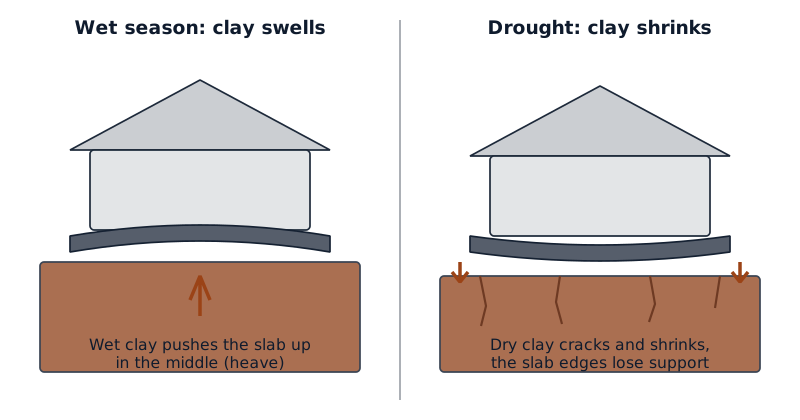
Houston adds a twist. Lake Charles clay, a common soil around the region, cracks open 1/2 to 2 inches wide at the surface when it dries, according to the USDA soil survey, and that drying and rewetting moves slabs from below. A crack that tracks the weather is not a plastic shrinkage crack, whatever it looked like at first. Our comparison of vertical vs horizontal foundation cracks helps if the crack is in brick or a stem wall, where horizontal cracks are the ones to take seriously.
Are plastic shrinkage cracks serious?
Usually not. Penn State's library says these cracks generally don't impair the structural performance of a slab. The concrete underneath them is sound, and they stop once the slab hardens. The real downsides are cosmetic and water: an open crack lets moisture, salts and grit into the surface, and the same source notes that cracks like these in some floors have been blamed for leaks.
The risk is mislabeling a newer movement crack as "just shrinkage". If you are unsure, when to worry about foundation cracks walks through the warning signs, and acceptable cracks in a concrete slab gives the width yardsticks builders use.
How do you repair plastic shrinkage cracks in a concrete slab?
You seal them. Because the cracks are shallow and the slab is sound, the fix is to clean the crack and fill or seal it so water and dirt stay out, not to rebuild anything. On a bare garage floor or patio this is a reasonable homeowner job. If the crack is under finished flooring or shows any of the movement signs above, stop and have it looked at first.
A sensible order for a garage slab or patio:
- Confirm it's shrinkage. Photograph it beside a ruler, then again after a dry month and after heavy rain. No change means a stable surface crack.
- Clean it out. Brush or vacuum loose dust and debris from the crack.
- Let it dry. Many crack fillers bond best to dry concrete, so wait for a dry spell and follow the product's own directions on moisture.
- Choose the filler for the width. Fine hairline cracks take a thin, low-viscosity penetrating sealer that wicks in. Wider cracks take a flexible concrete crack filler or a repair mortar.
- Fill, then finish flush. Work the filler in, scrape it level with the surface and keep traffic off it for the cure time on the label.
- Keep watching. Re-check the crack each season. A sealed crack that reopens wider is telling you something new.
This Old House puts professional crack filling at $250 to $800 nationally, a guide and not a quote. Epoxy injection for foundation cracks is the method used on deeper cracks that pass through a wall or slab, and it is usually more than a surface shrinkage crack needs.
Where DIY stops: cutting, coring, jacking or leveling a slab is foundation work, and the City of Houston issues building permits for foundation repair. Surface sealing is not that work, but anything that lifts or supports the slab is.
How do you prevent plastic shrinkage cracks when pouring a new slab?
Prevention is about slowing evaporation for the first few hours and starting curing early. Penn State's list covers dampening the subgrade and forms, cooling the concrete, avoiding overmixing, pouring early in the morning or late in the afternoon, putting up windbreaks and sunshades, spraying an evaporation retardant, using fog sprays to raise humidity, and wasting no time between finishing and curing.
If you are having a garage pad, driveway or patio poured, these are fair questions to ask the contractor before the truck arrives:
- What time of day will you pour, and what is the plan if it turns hot and windy?
- Will you dampen the ground and forms, and keep an evaporation retarder or fog spray on site?
- How and for how long will you cure the slab after finishing?
When should a foundation contractor look at the cracks?
Get a professional opinion when a crack appeared well after the slab was poured, keeps widening, has one edge higher than the other, runs out through the slab edge, lets water through, or comes with doors that stick, cracked brick or a floor that slopes. Any of those points to the soil or structure, not to how fast the surface dried on day one.
Houston houses almost never sit over a basement, so the slab is the foundation and the cracks you can see are often the only early warning you get. A visit covers the crack, floor levels and matching signs around the house. You get a written finding and a written price before any work starts. Our guide to concrete slab cracks covers the wider set of causes if a crack doesn't fit the shrinkage pattern.
Questions people ask
Can plastic shrinkage cracks get worse over time?
Not by themselves. Once the slab hardens, the cause is gone and the crack stops forming. What can happen is that water gets in, carries dirt or salts, and frays the edges, so the line looks worse. A crack that genuinely widens, lengthens or develops an offset has a different cause, usually soil movement under the slab, and needs a closer look.
Do plastic shrinkage cracks need waterproofing?
Usually only a seal at the surface. A penetrating sealer or flexible filler keeps rain and cleaning water out of the crack. Full waterproofing is meant for water coming through a slab from below, and that is rarely a shrinkage crack's doing. If water is rising through a crack, look for a plumbing leak or poor drainage around the house first.
Are hairline cracks in a new driveway the contractor's fault?
Not always. Some cracking is normal in any concrete, and fine hairline cracks can form even on a well-run pour if the weather turns. A crow's-foot pattern across the surface in the first days often points to fast drying, which curing and timing can reduce. Check your contract and any written warranty for what the contractor agreed to.
Can I pour a small patio myself without plastic shrinkage cracks?
You can cut the risk a lot. Pick a calm, cool day and start early, dampen the ground and forms before the concrete arrives, shade the slab from direct sun and keep wind off it. Start curing as soon as finishing is done and keep the surface damp. Rushing the finish on a hot, breezy afternoon is the usual cause.
How deep do plastic shrinkage cracks go?
Typically 2 to 4 inches, according to Penn State's concrete library, with widths around 1/8 inch. That is deep enough to look serious on a thin garage pad but still shallow compared with a crack running through the full thickness of a house slab. A crack you can see light or water pass through needs a professional look.
This guide is one of many on foundation repair houston.
Sources
Last changed