To fix uneven floors, first find out what is out of level: the floor covering, the subfloor, the framing under it, or the foundation itself. Surface dips can be filled with a leveling compound, sanded or shimmed, and you can often do that yourself. A floor that slopes because the slab or the piers below have moved needs the house lifted back, which is house leveling work for a foundation contractor. In Houston the second cause is common, because the clay under most homes shrinks and swells. This guide walks through how to tell the two apart, the fixes for each, and the flooring and transition tricks that hide what is left.
What causes uneven floors in a Houston home?
Uneven floors in a Houston home usually come from one of three things: the foundation moving on shrink-swell clay, sagging wood framing under a raised floor, or a poorly prepared surface under the flooring. The first is the most common here. The Lake Charles clay found across much of the area is 45 to 60% clay, according to the USDA, and it pulls away and settles in dry spells, then swells after rain.
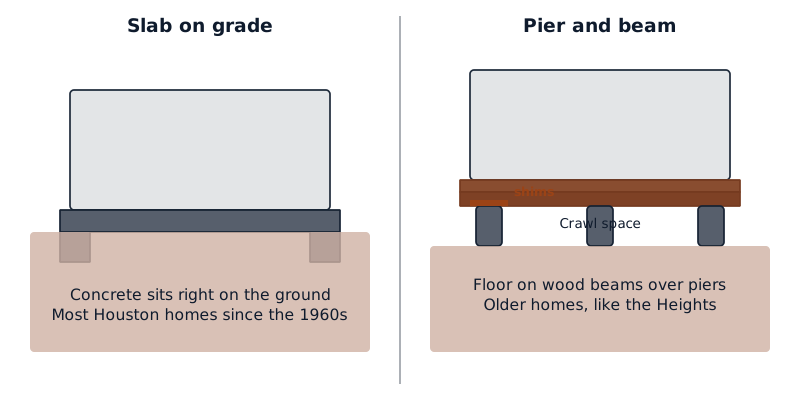
That movement is rarely even. One corner of a slab dries out faster than the rest, a leaking line softens the ground under a bathroom, or a big tree draws water from one side.
In older homes on pier and beam, the cause can sit higher up. Wood blocks and short piers sink, beams crack, joists sag over long spans, or a past repair used soft wood shims that have crushed. On any floor type, tile laid over a lumpy slab or laminate laid without a flat base will rock and gap even when the structure is fine.
Houston homes almost never have basement walls to bow inward, so look at the ground and the framing.
How do you tell if uneven floors are a foundation problem?
You can tell uneven floors are a foundation problem when the slope runs across a whole room or several rooms, and other signs show up with it: doors that stick or swing open, cracks over door frames, gaps where walls meet the ceiling, or brick cracks outside. A dip confined to one spot, with square doors and no cracks, points to the floor itself.
Before you start any repair, check these, ideally over a few weeks:
- Roll a marble or lay a long level across each room. Note which way things roll and whether the slope is gentle across the room or sudden in one place.
- Check doors and windows. Doors sticking or out of square near the low area is a strong clue the structure has moved.
- Walk the outside. Look for stair-step cracks in brick, a gap between the slab and the driveway or patio, and soil pulled back from the slab edge.
- Look under a raised floor. On pier and beam, check whether the piers are tilted, the shims are crushed or the beams are wet or split.
- Measure again later. Mark crack ends with a pencil and date them. Growth over a season means the house is still moving.
A professional foundation inspection takes elevation readings across the floor and gives you a map of high and low points. The Houston Press puts inspections at about $300 to $1,000, averaging around $600.
Can you relevel a house yourself?
You can't safely relevel a whole house yourself. Lifting a slab or a framed house takes hydraulic jacks, piers driven deep to firm soil, and readings taken as the lift happens, or the walls, pipes and windows crack. Inside the City of Houston, foundation repair runs under a building permit. What you can do yourself is fix the floor surface once the structure under it is sound.
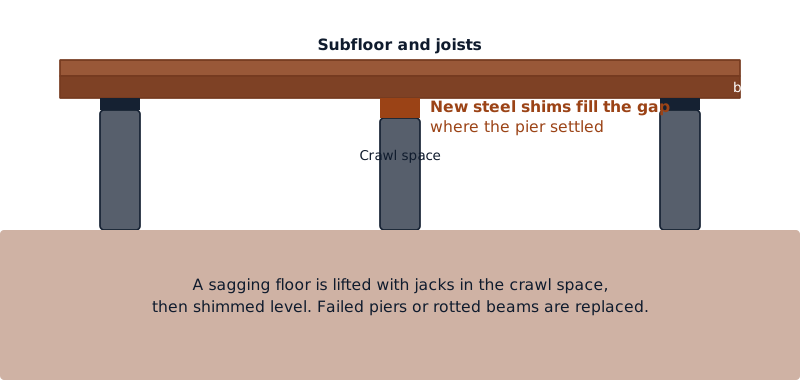
The city's permit reports list residential shim and level jobs too, so small raised-floor repairs count. Outside the city, ask your own building department first.
DIY is reasonable for:
- Filling low spots in a slab with self-leveling underlayment before new flooring
- Sanding high spots and ridges on a wood subfloor or an old hardwood floor
- Adding shims or sister joists to stiffen a bouncy floor when the piers below are sound
- Furniture fixes: adjustable feet, leveling pads, or locking casters on rolling pieces
Leave to a contractor: anything that lifts the house, replaces piers, or cuts into the slab.
How do you fix uneven floors on a slab foundation?
On a slab, fix uneven floors in two stages. If the slab has settled or heaved, a contractor lifts it on pressed concrete or steel piers until it is close to level again. After that, or if the slab never moved and was simply poured rough, you fill the low areas with self-leveling compound and grind down any high ridges before the new flooring goes on.
The structural stage is slab foundation repair. The Houston Press puts pressed concrete piers at about $300 to $600 each here and steel piers at $1,000 and up, with most Houston jobs between $3,300 and $6,800. Work inside the house adds about 15%.
The surface stage is where you can save money:
| Problem on the slab | Typical fix | DIY? |
|---|---|---|
| Shallow dips and low spots | Self-leveling underlayment poured over a primed slab | Yes, for small rooms |
| High ridges or old adhesive bumps | Grinding with a rented concrete grinder | Yes, with dust control |
| Cracks that have not opened further | Crack filler before flooring | Yes |
| Whole room sloping to one side | Pier lift, then surface work | No |
| Garage, patio or driveway slab that has sunk | Mudjacking or foam lifting | No |
For the outside slabs, see mudjacking, which This Old House prices at about $550 to $1,300 a job.
How do you level a floor in an old pier and beam house?
To level a floor in an old pier and beam house, start in the crawl space. Reset or replace sunken piers, replace crushed or rotted shims with hard material such as steel or treated hardwood, and add support under sagging beams. Then fix any remaining dips from above by sistering joists or planing the subfloor. The house is jacked up in small steps, never all at once.
Many of the older Houston homes are built this way. The city's Houston Heights design guidelines describe houses there as mostly wood siding on pier-and-beam foundations, with Craftsman bungalows popular from 1905 to 1925. A century of soil movement leaves those floors with a gentle wave that is normal in an old house.
Lifting a long-settled bungalow fully level can crack plaster and trim that adjusted to the old shape, so the goal is often "level enough": stop the movement and take out the worst slope. Pier and beam foundation repair explains the work in more detail.
What are the best flooring options for uneven floors?
The best flooring for uneven floors is one that flexes or floats: luxury vinyl plank, sheet vinyl, carpet over a good pad, and click-together laminate on a flat enough base. Large rigid tile and solid hardwood are the hardest to lay well over dips, because they crack or rock where the floor is not flat. Whatever you choose, fix structural movement first.
Some practical points:
- Floating floors bridge small dips, but each product has a flatness limit in its installation instructions. Go past it and joints open or click.
- Tile needs the flattest base. Large-format tile shows every hollow.
- Transitions and thresholds. Where two rooms meet at different heights, a reducer strip or a beveled threshold covers the step. On a sloping floor, a flexible transition strip can follow the line. A door sweep or an adjustable threshold closes the gap under a door left uneven by the slope.
When should you call a foundation contractor about uneven floors?
Call a foundation contractor when the floor slope is getting worse, when doors and cracks show the walls are moving with the floor, or when a raised floor feels soft or springy near the piers. Those mean the support under the house is failing, and new flooring will only hide it for a while. Early repair keeps the job smaller.
This Old House notes that a hairline crack sealed for $250 to $800 can become a $10,000 to $15,000 repair if it is left. Moisture also plays a part: water pooling against the slab speeds up clay movement, so foundation drainage is often part of the fix. For what a lift costs, see foundation leveling cost.
If you're weighing whether the slope is a safety issue, are uneven floors dangerous goes through the warning signs. When you're ready, we'll arrange a visit from a local foundation contractor, who checks the floor and gives you a written quote before any work starts.
Questions people ask
Can shims fix uneven floors?
Shims can fix uneven floors on a raised wood floor when the piers below are sound and only small gaps need closing between pier and beam. Use hard shims such as steel, not soft wood that crushes. Shims will not fix a slab, and they will not stop a pier that keeps sinking. In that case the pier itself has to be reset or replaced.
Can you sand uneven floors flat?
You can sand a wood floor or subfloor to take off high edges, cupped boards and small ridges, but sanding cannot fix a slope. Solid hardwood only has so much wear layer to give, and engineered wood has less. For dips larger than a sanding pass can handle, fill the low spots instead, or level the structure first.
Do casters work on uneven floors?
Locking casters with larger wheels roll better over uneven floors than small ones, and they stop a desk chair or cart from drifting downhill once locked. For furniture that should stay put, such as a bookcase or a dresser, adjustable leveling feet work better than casters or folded card.
How long does it take to fix uneven floors?
Surface fixes, such as pouring self-leveling compound or sanding, take a day or two in one room plus drying time. Lifting the house takes longer: a slab pier job usually runs a few days on site, and a permit or an engineer's report can add time before work starts. New flooring goes on only after the lift settles.
Do I need a permit to level my floors in Houston?
Inside the City of Houston, foundation repair needs a building permit, and the city's permit reports include shim and level work on raised foundations. Replacing flooring or pouring underlayment on its own is a different matter. Outside the city, ask your own city's building department. In the Heights historic districts, outside changes can also need a Certificate of Appropriateness.
The rest of our guides start from foundation repair across Houston.
Sources
Last changed