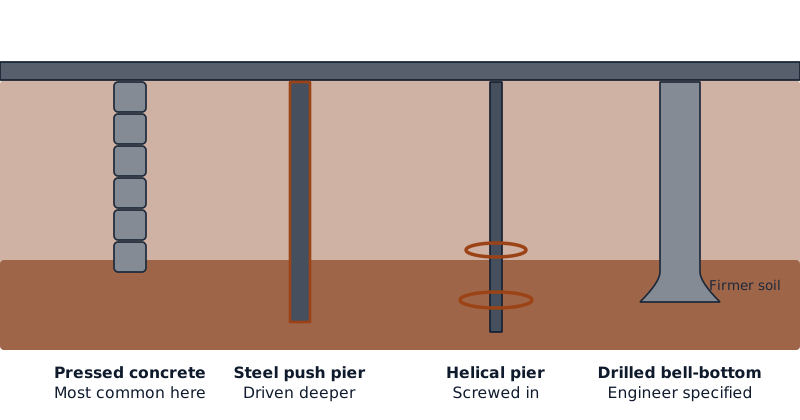
A concrete footing is a shallow pad of poured concrete that spreads a load over the soil near the surface. A helical pier is a steel shaft with screw plates, turned deep into the ground until it bears on firmer soil below. In Houston that depth is the whole argument: a footing at the code minimum of 12 inches sits inside clay that swells and shrinks every year, while a helical pier can be taken below it. This article compares the two for new supports, such as a porch, an addition or a replaced pier under a raised house. The wider range of pier types is on foundation piers in Houston.
What's the difference between helical piers and concrete footings?
The difference is where each one finds its support. A concrete footing is dug, formed and poured, and it carries weight by pressing on the soil directly beneath it, usually within the top few feet. A helical pier is screwed in by a hydraulic motor and carries weight on its plates at whatever depth the design sets. One spreads load wide and shallow; the other reaches down.
| Concrete footing | Helical pier | |
|---|---|---|
| What it is | Poured concrete pad or strip, often under a block or concrete pier | Steel shaft with one or more helical plates |
| How it goes in | Dig, form, pour, cure | Screwed in with a hydraulic torque motor |
| Typical depth | Code minimum 12 inches below undisturbed ground, deeper by design | Set by the design, often well below the active clay |
| Ready to load | After the concrete has cured | As soon as it's installed and bracketed |
| How capacity is checked | Soil bearing value and footing size | Torque correlations, plate bearing area, load tests where required |
| Resists uplift | Only by its own weight and what's on it | Yes, if designed for tension |
| Spoil and mess | A hole for every footing, soil to haul | Little digging, small pits at the head |
The word "footing" also gets used loosely for a drilled concrete pier, a hole augered deeper and filled with concrete and steel. That is closer to a helical pier in purpose, and it's covered further down.
What's the difference between pile and pier foundation?
In strict terms, a pile is driven or screwed into the ground and a pier is drilled or dug, then filled with concrete. By that rule a helical pier is really a pile, which is why you'll see "helical piles" and "helical piers" on quotes for the same steel product. A footing is neither: it's a shallow foundation that bears on the soil right under it.
Houston contractors call almost everything a pier, so ask what's actually going in the ground. The steel options, push and helical, are compared on helical vs push piers.
Why do shallow concrete footings struggle in Houston clay?
Shallow footings struggle here because the soil around them moves. The USDA describes Lake Charles clay, common across the Houston area, as 45 to 60% clay that cracks half an inch to two inches wide when dry, with cracks reaching 12 inches or more deep and staying open 60 to 90 days in most years. A footing at the 12 inch code minimum sits right in that band.
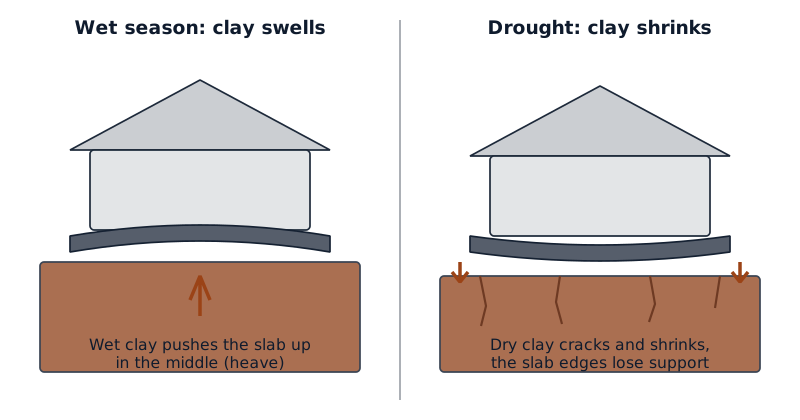
When the clay dries it shrinks away from the footing and the support drops. When rain returns, water runs straight into the open cracks, the clay swells and pushes the footing back up. Beaumont clay, east of the Trinity River, behaves the same way on a smaller scale. A porch or addition on shallow footings beside a slab house can rise and fall on a different cycle from the house, which shows as a crack where the two meet.
The building code sees this coming. The residential code says foundations on expansive soils must be designed to the International Building Code's expansive soil section, and lets the building official ask for a soil test where the ground is likely to be expansive. That section says a foundation placed within the active zone must resist the forces from the soil's volume change or be isolated from it. A deep pier is one way to do that. A shallow footing usually needs to be designed for the movement instead.
When does a concrete footing or drilled pier still make sense?
A concrete footing still makes sense for light, forgiving structures where a little seasonal movement does no harm, such as a garden shed, a detached deck step or a fence line. A drilled and belled concrete pier, designed by an engineer, is a common choice in new construction where a drill rig can reach the site and there's time for the concrete to cure.
Concrete has real advantages. It doesn't corrode, the materials are familiar to every crew, and for a small job the per-support cost is often lower. The trade-offs:
- Curing time. Poured concrete has to gain strength before it carries load, which holds the next stage of work back. A helical pier takes load once it's installed.
- Digging and spoil. Each footing or drilled pier means a hole and soil to remove, hard under a low raised floor or in a tight side yard.
- Weather. Pouring in a waterlogged hole after a Houston downpour is poor practice; screwing in steel is less affected.
- Uplift. A footing resists swelling clay only by its own weight and the load on it. A helical pier designed for tension holds down as well as up.
For pressed concrete repair piers under an existing slab, which are a different thing from footings, see concrete foundation piers.
How do helical piers vs concrete footings compare on cost?
Per support, steel helical piers usually cost more than concrete. A 2026 Houston Press guide puts steel piers at $1,000 or more each and pressed concrete piers at about $300 to $600. This Old House puts piering at $1,000 to $3,000 per pier nationally. No reliable published figure covers a plain concrete footing on its own, because it varies so much with size and depth.
| Item | Typical range | Source |
|---|---|---|
| Steel pier, helical or push, each | $1,000 and up | Houston guide, 2026 |
| Pressed concrete pier, each | $300 to $600 | Houston guide, 2026 |
| Piering or underpinning, each pier | $1,000 to $3,000 | National guide, 2026 |
| Soil report | $500 to $3,000 | National guide, 2026 |
| Structural engineer report | $500 to $1,000 | National guide, 2026 |
| Permit | $75 to $150 | National guide, 2026 |
The cheaper option per hole isn't always the cheaper job. A footing that moves can mean a second repair, and This Old House notes that small problems left alone can grow into $10,000 to $15,000 repairs. Access adds cost too: the Houston guide says decks, tight side yards and landscaping add 6 to 8% to pier work. These are guides; the written quote sets your price. The per-pier breakdown is on pier foundation cost.
Which should you use for a porch, addition or raised house in Houston?
For anything joined to a house, such as a room addition, a covered porch tied into the roof or a new support under a pier-and-beam floor, helical piers are frequently the safer choice in Houston clay, because they reach below the soil that moves and can resist uplift. For a separate, light structure that can move a little, a well-built concrete footing is often enough.
A simple way to decide:
- Is it attached to the house? If yes, it should move with the house, not with the top foot of clay. Lean toward deep supports.
- How heavy is it? Light loads suit helical piers well, since they don't rely on weight to drive them.
- Can a rig or a crew reach the spot? Low crawl spaces and narrow side yards favor helical piers.
- Does it need to hold down as well as up? Uplift from swelling clay or wind points to helical piers designed for tension.
- What does the design say? On expansive soil the code expects a design, so let an engineer set the type and depth.
Under older raised homes, replacing rotted wood posts or tilted block piers on shallow pads is a common job; pier and beam foundation repair explains how that work runs, and helical pier foundation repair walks through the helical method step by step.
What does the building code say about each?
The residential code sets concrete footings at least 12 inches wide and 6 inches thick, placed at least 12 inches below undisturbed ground, with width based on the soil's bearing value. For helical piles, the building code bases capacity on the lowest of several checks, including plate bearing and installation torque, requires installation to the depth and torque a registered design professional sets, and calls for special inspection.
In practice, that means a helical quote should name the target torque and depth for each pier, and you should get a log showing what each one reached. A footing quote should give the footing size and depth. Inside the City of Houston, foundation work runs under a building permit; the city's weekly permit reports list foundation repair permits by the dozen. Other cities, such as Bellaire, add their own floodplain permit. Small DIY footings for sheds and decks are covered on DIY foundation piers; anything carrying part of a house is a job for a contractor and a permit.
If you want both options priced, we'll arrange a visit from a local foundation contractor, and you get the price in writing before any work starts. Ask for a written quote.
Questions people ask
Are helical piles stronger than concrete piers?
Not always. Strength depends on the design, the depth and the soil, not the material alone. A large drilled concrete pier can carry more than a small helical pile. What helical piles offer in Houston is reach below the moving clay, a capacity checked by torque as each one goes in, and resistance to uplift when designed for it. Concrete wins on corrosion and, often, on price per support.
How long does each one take to install?
A helical pier carries load as soon as it's installed and bracketed, so the next stage can usually follow the same day. A poured footing or drilled pier needs digging, forming and time for the concrete to cure before it takes the load. The overall job length depends on the number of supports and access, so ask for a timeline in the written quote.
Can helical piers be added beside existing concrete footings?
Yes. A common Houston repair adds helical piers under a beam whose old footings have sunk or tilted, then lifts the beam back toward level and ties it to the new piers. The old footings may stay in place. The design should say which supports carry the load afterward, so the house doesn't end up resting on a mix that moves differently.
Do I need a soil test before choosing?
Often it helps, and on expansive clay the building official can require one. A soil report tells the engineer how deep the active zone runs and what the firmer soil below can carry, which sets the footing size or the helical pier depth. This Old House puts soil reports at about $500 to $3,000. A structural engineer foundation inspection can tell you whether one is worth it.
What should I ask a contractor proposing either one?
Ask why they chose that support for your soil, how deep each will go and how they'll prove it, for example a torque log for helical piers. Ask who designed the layout, who pulls the building permit, and whether special inspection is included. Get each quote itemized by support so you can compare a footing plan and a helical plan line by line.
This guide is one of many on Foundation Repairs Houston Quotes.
Sources
- International Residential Code 2021, Texas edition, Chapter 4 (Sections R401.4, R403.1.1, R403.1.4, R403.1.8)
- International Building Code 2021, Texas edition, Chapter 18 (Sections 1808.6, 1809.4, 1810.3.3.1.9, 1810.4.11, 1810.4.12)
- USDA NRCS, Lake Charles soil series description
- USDA NRCS, Beaumont soil series description
- Houston Press, guide to foundation repair in Houston (2026)
- This Old House, foundation repair cost guide (October 2026)
- City of Houston weekly building permit report, July 2024
Last changed