A foundation root barrier is a vertical wall of plastic set into a trench between a tree and your house, so the tree's roots can't reach the clay under the slab. In Houston the danger from roots is rarely a root pushing on concrete. It's the tree drinking the clay dry so it shrinks and the slab edge drops. A barrier keeps those roots out of that strip of soil. It works best before the house moves, it won't lift a slab that already has, and it can harm the tree. This page sits under our guide to foundation watering and trees and covers depth, placement, materials, installation and the alternatives.
How does a tree damage a foundation on Houston clay?
Mostly by drying the soil, not by pushing on the slab. A large tree pulls water from the clay around its roots, and clay that loses water shrinks. When that happens under one side of a house, that side of the slab loses support and settles while the rest stays put. The result is cracks, sloping floors and doors that bind, usually on the side nearest the tree.
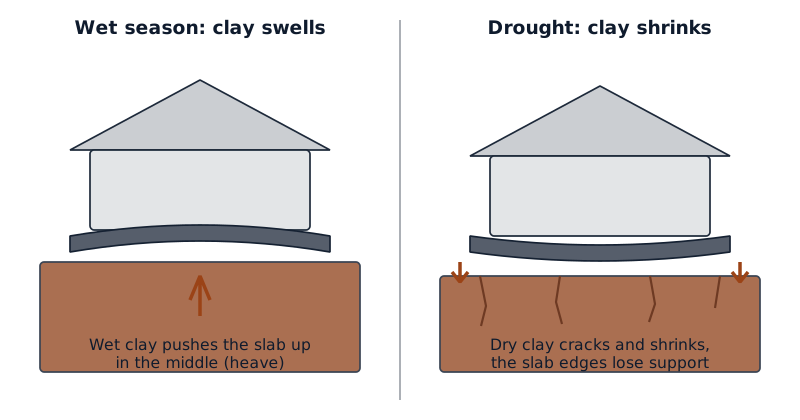
The clay under much of the Houston area moves a lot. The USDA describes the Lake Charles series as 45 to 60% clay. In a dry season it opens cracks up to 2 inches wide that run a foot or more down, and those cracks stay open for 60 to 90 days in most years. A thirsty oak keeps that soil drier than the rest of the yard for longer.
The ASCE Texas Section guideline for residential foundations says the same thing in engineering terms: trees or large shrubs near a foundation may cause soil shrinkage under it. If you're seeing that kind of movement, settling and soil movement explains how it shows up across the house.
Does a root barrier actually protect a foundation?
It can, as one part of keeping the soil under the slab at a steady moisture. The ASCE Texas guideline lists root barriers, or periodic root pruning, as a non-structural measure that may reduce the effects of trees. It doesn't promise a result, and it warns that installing one may harm the tree, so it advises asking an experienced arborist how to limit that damage before you dig.
Be realistic about what a barrier does:
- It stops new roots from reaching the slab soil. The clay inside the barrier then dries and wets with the weather, not with the tree.
- It does not lift anything. A corner that has already dropped stays where it is. Lifting is a foundation leveling job.
- It works with watering, not instead of it. The soil between the barrier and the slab still needs even moisture in a drought, which is where a soaker hose comes in.
- Roots can go under or around it. A shallow barrier or a gap at the ends leaves a path.
How deep and how far from the house should a root barrier go?
There is no single code figure, so depth comes from the tree and the soil. Most tree roots are shallow: an extension expert answering a Texas homeowner put 80 to 90% of a tree's roots in the top 18 inches, and nearer the surface in moist clay. In that answer, a barrier 36 inches deep was judged adequate for a live oak, with the homeowner's engineer asking for 48 inches.
Placement matters as much as depth. The same extension answer made three points worth following:
| Decision | What to aim for | Why |
|---|---|---|
| Distance from the house | Leave a few feet of soil between the barrier and the slab | That buffer keeps the soil under the foundation outside the tree's reach |
| Distance from the trunk | Stay out near the edge of the canopy, not tight to the trunk | Cutting roots close to the trunk takes more of the tree's support and water |
| How far around the tree | Don't wrap the trench around much of the trunk | Cutting roots on half the tree or more can badly weaken it |
| Depth | Deep enough to pass most of the root mass, often 3 to 4 feet in clay | Roots that pass under a shallow barrier reach the slab soil anyway |
Long runs also need sound joins. Where two panels meet, the ends should overlap and be sealed so roots can't find the seam, and the barrier should run past the tree's spread along the perimeter, not stop level with the trunk.
What is a root barrier made of, and is a kit enough?
Most root barriers are rigid or heavy plastic panels, sold in rolls or as panels by the foot. Some homeowners buy a root barrier kit with panels and joining strips. A kit gives you the material. The hard part is the trench: a narrow cut several feet deep in Houston clay, along the right line, that doesn't sever more roots than the tree can lose.
A kit can work for a small tree or a shrub bed against the house. For a mature oak or pecan near a slab, think twice before doing it yourself. Digging a 3 to 4 foot trench by hand in wet clay is slow, the spoil is heavy, and a narrow trench that deep can collapse. A trencher rented for the job cuts every root in its path, so the line and depth have to be right first.
The ASCE Texas guideline also describes a related product: vertical moisture barriers of durable plastic sheeting attached to the foundation, which slow moisture moving in and out under the slab. That is a different job from a root barrier set out in the yard, and it's usually part of a wider foundation plan.
How is a foundation root barrier installed?
The work follows the same order whether you do it or a contractor does. Mark the line, call 811 so buried lines are marked, cut the trench, set and join the barrier, then backfill and water. The Railroad Commission of Texas says homeowners, excavators and contractors are required by law to call 811 at least two days before digging, and the call is free.
- Have the tree looked at. An arborist can tell you how much root loss the tree can take and where the line should run.
- Mark the line. Keep the buffer from the slab and the distance from the trunk set out in the table above.
- Call 811. Gas, water, power and cable lines often run across Houston front yards near the house.
- Cut the trench to the planned depth, with clean cuts on the roots rather than torn ones.
- Set the barrier with its top edge about an inch above the soil surface, the height at which no roots grew over the barriers in one arboriculture study, and overlap and seal the ends of each panel.
- Backfill and firm the soil, then water it in. Keep the bed between the barrier and the slab evenly moist from then on.
How to install a soaker hose for your foundation covers the watering line that usually goes in alongside.
Should you cut down the tree instead of putting in a barrier?
Not without advice. Removing a large tree stops it drying the clay, but the soil it kept dry then takes on water and swells. The ASCE Texas guideline warns that removal may cause upheaval, especially when the tree is older than the house, and says an engineer may recommend waiting for that heave to happen before repairs. Pruning may be a safer middle step.
That's why a root barrier is often the first choice for a big old tree on a Houston lot: it keeps the tree and limits its reach. If you've already taken a tree out and the floor near that spot is rising, foundation heave repair explains how that's handled.
One more check before any work near the street: a tree in the strip between the sidewalk and the curb may belong to the city, not to you. Ask the City of Houston before cutting its roots.
When does a root barrier need a foundation contractor or engineer?
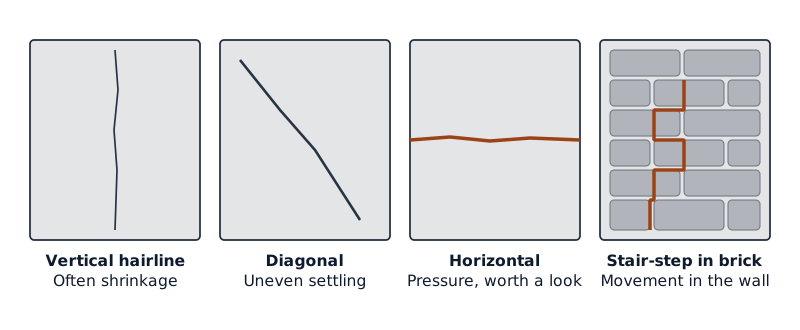
When the house has already moved. If you see stair-step cracks in brick, doors that stick on the side facing the tree, or a floor that slopes toward it, get the foundation measured before you dig. A floor elevation survey shows whether that side has dropped, and whether a barrier alone is enough or the slab also needs support.
The ASCE Texas guideline suggests trying non-structural measures and monitoring the house before or instead of structural repairs where that's sensible. A structural engineer's report can set the barrier's line and depth and say whether piers are needed too. If lifting is needed inside the City of Houston, that repair is done under a building permit.
When you ask for a visit, a local foundation contractor checks the floor levels, the cracks and the trees near the house, then explains what they found. Any price comes to you in writing before any work starts.
Questions people ask
How long does a foundation root barrier take to install?
A single run along one side of a house is often a day's work once the line is marked, though the 811 call adds at least two days before digging can start. Longer runs, hand digging around roots and heavy wet clay all add time. The tree survey and any engineer's visit come first, so plan on a week or more from first call to a finished barrier.
Do I need to be home for a root barrier installation?
Not for the digging itself, as long as the contractor can reach the yard and the faucet. It helps to be there at the start to agree the line, the depth and what happens to plants in the bed, and at the end to see the trench backfilled and watered. If an engineer or arborist is visiting first, be home for that so you can ask questions.
What should I ask before I hire someone to put in a root barrier?
Ask how deep the barrier will go and why, how far it sits from the slab and the trunk, and how the panel ends are joined. Ask whether they will call 811, whether an arborist has looked at the tree, and whether they will measure the floor level first. Get the scope and the price in writing, including backfill, cleanup and replacing the bed.
Will a root barrier kill my tree?
It can weaken it, and the ASCE Texas guideline warns that installation may harm the tree. The risk rises when the trench runs close to the trunk or around a large part of it, because cutting roots takes away water and anchorage. Keeping the line out near the canopy edge, cutting roots cleanly and watering the tree well afterward all lower the risk. An arborist can judge it for your tree.
Is a root barrier worth it if my foundation already has cracks?
Only as part of a fix. A barrier stops the tree making things worse, but it won't close cracks or lift a dropped corner. Have the foundation checked first. If the movement is small and seasonal, a barrier plus steady watering may be enough. If a section has dropped, it may need slab foundation repair as well, and the barrier then protects that work.
For the wider picture, start with foundation repair houston.
Sources
- ASCE Texas Section, Guidelines for the Evaluation and Repair of Residential Foundations, Version 3 (April 2022), sections 7.3.2, 7.3.3 and 7.3.6
- Ask Extension, root barrier depth and placement near a live oak in Dallas County, Texas (2014)
- USDA NRCS, Lake Charles soil series description
- Arboriculture and Urban Forestry (International Society of Arboriculture), root barrier and extension casing effects on Chinese hackberry
- Railroad Commission of Texas, call 811 before digging
- City of Houston weekly building permit report, July 2024
Last changed