Foundation floor cracks usually show up in your flooring before you ever see the concrete. A straight crack that runs across several tiles, a ridge rising in vinyl plank, or a seam opening in wood flooring often traces a crack in the slab underneath. Many of those are hairline cracks from the concrete drying and are harmless. The ones that matter are wide, offset or growing, or come with a floor you can feel slope. Here's how to read each kind of flooring, check the slab under it, and protect your floor during a repair. For every repair method, see foundation crack repair in Houston.
What do foundation floor cracks look like inside a house?
Inside a house, foundation floor cracks rarely look like bare concrete. You see their effect on the floor covering: a line of cracked tiles or split grout running in one direction, a hump or gap in vinyl plank, boards that separate along a line, or a ridge you feel through carpet. The pattern matters more than any one crack. A line that crosses a whole room points to the slab.
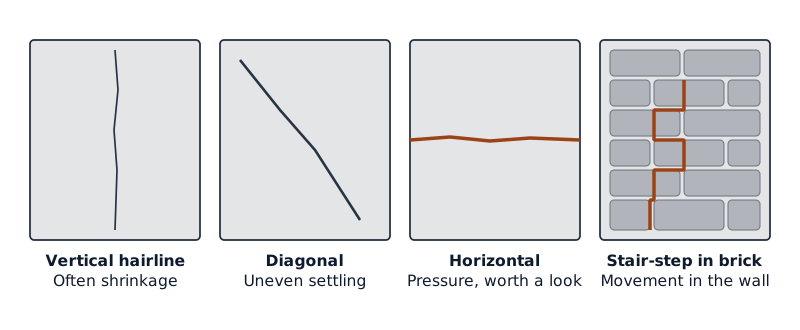
A flooring fault tends to stay local: one cracked tile by the fridge, or a gap where two planks meet in the sun. Slab movement draws a longer line that carries on under the next tile, past a doorway, or lines up with a crack in a wall or the brick outside.
Is a crack in a tile floor a foundation problem?
A crack in a tile floor is a foundation problem when it runs straight across several tiles and grout lines in a continuous line, because tile bonded to a slab breaks where the concrete breaks. A single cracked tile, or cracks that follow grout lines only, more often come from a hollow spot under the tile, a dropped object or the tile installation itself, not the foundation.
How each flooring shows slab movement:
| Flooring | What a slab crack looks like through it | What else causes the same sign |
|---|---|---|
| Ceramic or porcelain tile | A straight crack crossing several tiles and grout joints | Hollow spots under single tiles, impact damage |
| Vinyl plank or sheet vinyl | A ridge or a clean split along one line | Plank joints parting with heat, a poorly prepared floor |
| Wood or engineered wood | Boards parting or pushed up along a line | Cupping and gaps from humidity |
| Carpet | A raised line you feel underfoot | Loose pad or a lifted tack strip |
| Stained or polished concrete | The crack itself, visible and measurable | Planned saw cuts that look like cracks |
Tap the tiles near the crack with a coin. A hollow sound around one tile suggests a bonding problem. Solid tiles with a straight crack through them point back to the concrete.
How do you check the slab under carpet, wood or vinyl?
To check the slab under a floor covering, look where the covering ends: a closet corner, a doorway threshold strip or a floor vent. Lift carpet back from the tack strip in a closet, or pull a vent cover. If you can see the concrete, measure the crack's width, check whether one side sits higher, and photograph it next to a ruler with the date.
- Follow the line. Look for a matching crack in the garage floor, the slab edge outside or the drywall above.
- Measure and mark. Pencil the ends of any crack you can see and note the width at one spot.
- Check level. A long level, or a marble rolling the same way every time, shows whether the floor slopes.
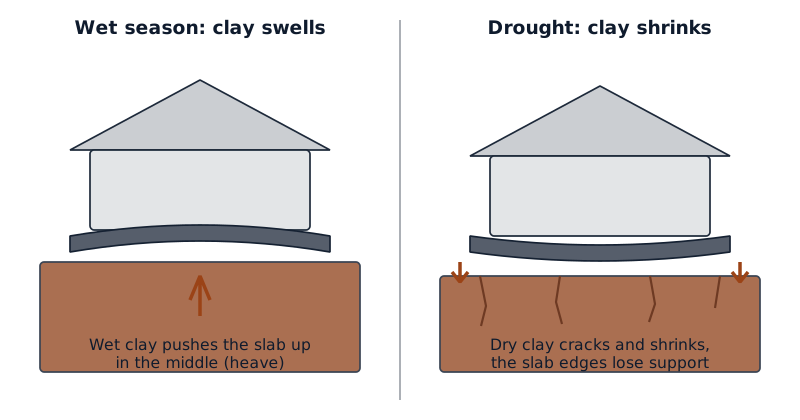
- Recheck through the seasons. Houston clay shrinks hard in dry spells. The USDA says Lake Charles clay can open cracks 1/2 to 2 inches wide in the ground, open for 60 to 90 days in most years, so a floor crack that changes between summer and the wet season is still moving.
Never cut into the slab itself: if it's post-tensioned, that's dangerous, as concrete slab cracks explains. The width and offset thresholds that separate a cosmetic crack from a serious one are on when to worry about foundation cracks.
Can moisture come up through a crack in a slab floor?
Yes, moisture can come up through a slab floor, crack or not. The Department of Energy's Building America guidance says concrete wicks liquid water in any direction, including upward, which is why slabs are poured over a capillary break and a polyethylene sheet of at least 6 mil. A crack gives that moisture an easier path, and floor coverings can trap it.
Wood that cups near the crack, adhesive letting go under plank, a musty smell under carpet or white powder along the crack all point to moisture, not just movement. On a slab at grade, the usual cause is water at the outside of the house or a leak in the plumbing below it, and sealing the crack alone rarely ends it. Leak signs such as a warm spot on the floor or an unexplained water bill are covered on slab leak symptoms. Online advice about basement waterproofing and horizontal cracks in basement walls rarely applies, because Houston homes almost never have a basement. Here the fixes are drainage, a leak repair and a sealed crack.
What if your house is pier and beam, not a slab?
If your house is pier and beam, the floor sits on wood framing above a crawl space, so there's no concrete floor to crack. Floor cracks there show as split tile, gaps at the baseboards or boards that bounce, and they usually mean a sagging joist, a sinking pier or a shim that has dried out and slipped. The fix happens under the house, not in the floor.
City of Houston design guidelines describe homes in Houston Heights as mostly pier and beam. The crawl space lets a contractor reach the problem without breaking flooring. Pier and beam foundation repair covers how shimming and pier replacement are done.
What happens to your floor when the foundation is repaired?
When a slab is repaired, your floor is part of the job. Piers usually go in from outside the house, but where support is needed under an inside section, flooring gets lifted and the slab cut open. A 2026 Houston guide puts interior work at about 15% more. Lifting a slab toward level can also crack tile and grout that were whole before, so wait to replace flooring.
A sensible order of work:
- Stop the cause. Fix any leak or drainage problem feeding the clay.
- Stabilize the slab. Piers or other support, then a lift toward level where the contractor recommends it.
- Seal what remains. A stable crack gets sealed; a 2026 national guide puts crack filling at about $250 to $800.
- Then the floor. Replace tile or plank once the slab has been still through a full season. How to fix uneven floors covers leveling compounds.
In the City of Houston, foundation repair needs a building permit; one week of city permit reports in July 2024 listed 23 of them. New flooring is your call. Cutting, lifting or piering the slab is work for a contractor who pulls that permit.
When does a floor crack need a foundation contractor?
A floor crack needs a foundation contractor when it crosses a room in a straight line, one side sits higher than the other, it keeps getting wider, or it comes with sticking doors, cracks in drywall or a floor you can feel slope. Those signs mean the soil is moving the slab, and the fix is underneath the house.
Hairline cracks that stay the same width through a year, with no slope, can usually be sealed when you replace the flooring. A Houston guide puts an inspection at about $300 to $1,000, and a contractor's visit often starts with a floor level survey that maps the high and low spots across every room.
If your tile or plank is showing a line you can't explain, we'll arrange a visit from a local foundation contractor who checks the slab, maps the floor levels and gives you a written quote for the floor crack before any work starts.
Questions people ask
Can I just replace the cracked tiles?
You can, if the crack under them has stopped moving. Lift the cracked tiles, check the slab, seal a stable crack, and lay the new tile. If the slab crack is still opening or one side has dropped, new tile will crack along the same line, often within a season. Watch it through a dry summer before buying flooring.
Are hairline cracks in a garage or house floor normal?
Yes, hairline cracks in a slab are common and usually come from the concrete drying out after the pour. They tend to appear in the first year or two and then stop changing. They aren't serious on their own. Watch for width you can fit a coin into, one edge higher than the other, or a crack that grows between seasons.
Will a floor crack get worse in a Houston summer?
It can. Houston's clay soils shrink as they dry, so the ground under a slab edge loses support in a long dry spell and the slab can bend. A crack that widens in summer and narrows after the rains is still moving with the soil. Steady watering around the foundation and good drainage reduce that swing, but they don't fix a slab that has already settled.
Does homeowners insurance cover cracks in a slab floor?
Usually not. The Texas Department of Insurance lists earth movement and wear and tear among the risks most policies don't cover, and a continuous leak is excluded too. A sudden, accidental release of water is usually covered, and some insurers sell an optional endorsement for damage to foundations or slabs. Coverage varies by company, so check your policy before work starts.
The rest of our guides start from Foundation Repairs Houston Quotes.
Sources
- USDA NRCS, Lake Charles soil series description
- US Department of Energy Building America Solution Center, capillary break beneath slab
- City of Houston, Houston Heights design guidelines
- City of Houston weekly building permit report, July 2024
- This Old House, foundation repair cost guide (October 2026)
- Houston Press, guide to foundation repair in Houston (2026)
- Texas Department of Insurance, home insurance guide
Last changed