To install foundation drainage, work from the surface down. First watch where water goes in a heavy rain. Then fix the cheap things: gutters, downspout extensions and soil graded away from the slab. Only if water still lingers do you install a French drain: a fabric-lined trench with washed gravel and a perforated pipe that falls steadily to an outlet at least 10 feet from the house. Our foundation drainage guide explains which drainage systems suit Houston homes and what they cost. This page is the hands-on part: how to read your lot, how to set the fall, how to lay the pipe, and where DIY should stop.
Can I install my own French drain?
Yes, if the run is short, it sits in the yard rather than tight against the slab, and the ground falls to a real outlet. A careful homeowner with a shovel, a string line and a level can do it. Leave it to a contractor when the trench must go down beside the foundation beam, when there is no low point and the water needs a pump, or when the work ties into a storm sewer.
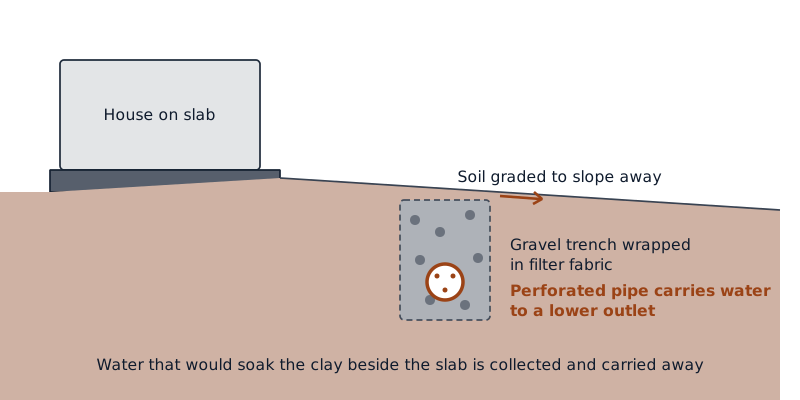
On flat Houston lots the hard part is rarely the digging. It's finding somewhere lower for the water to go.
How do I find out where the water around my foundation comes from?
Walk the house during a heavy rain and again an hour after it stops. Note where water pours off the roof, where it runs across the yard, and where it stands against the slab. Puddles under a valley in the roof point to gutters. A wet strip along one wall points to grade. Water that lingers a day or more in the middle of the yard is a drain problem.
Mark each spot with a flag or a photo. The USDA describes Lake Charles clay as very slowly permeable once wet, though water pours into its cracks when it's dry, so watch in both a dry spell and a wet one if you can. If water seems to appear from under the slab with no rain at all, that's a plumbing question, not a drainage one: see foundation drainage pipe and slab leaks.
How do I fix drainage problems around a foundation without digging a drain?
Most foundation drainage problems are fixed at the surface. Clean the gutters, add downspout extensions that carry roof water well out into the yard, and rebuild the soil so it falls away from the house. The residential code Texas uses asks for at least 6 inches of fall in the first 10 feet. Do these first. Many homes never need a buried pipe after them.
How to make good drainage around a house foundation, in order:
- Gutters. Clear them and check they slope toward each downspout.
- Downspouts. Extend each one so water lands on ground that falls away from the house.
- Grade. Add topsoil against the wall and rake it out so it drops at least 6 inches over 10 feet. A level on a straight board shows the fall.
- Hard surfaces. Code says paving within 10 feet of the foundation should slope at least 2% away.
- Beds. Keep mulch and soil below the top of the slab.
Where a lot line or a wall makes 6 inches of fall impossible, the code allows drains or swales instead. That's the point to consider a French drain. Watering the foundation in a drought is the other half of moisture control on clay, covered in soaker hoses for a foundation.
How do you plan the route and fall for foundation drainage pipe?
Plan the outlet first, then work back to the wet spot. The pipe has to drop all the way. Washington State University Extension recommends a fall of 0.5% to 1%, which is 6 to 12 inches over 100 feet. The federal Building America guide says the outlet should discharge to daylight at least 10 feet from the foundation, or to a dry well or a storm sewer the city approves.
To check the fall, drive a stake at the wet spot and another at the outlet, run a string between them and level it with a line level. Measure from the string down to the ground at each stake; the difference is your fall. Six inches over 60 feet is about 0.8%, which works. Two inches doesn't. About 1/8 inch per foot is close to 1%. If the outlet sits level with the wet spot, the answer is a pump or a dry well, and that's contractor work. The choice between a yard French drain and a deeper footing drain is set out in foundation drain vs French drain.
How do you install foundation drainage pipe, step by step?
Call 811, dig a trench that falls toward the outlet, and line it with filter fabric. Lay at least 2 inches of washed gravel. Set the perforated pipe with its holes facing down, cover it with about 6 inches more gravel, and fold the fabric over the top. Run solid pipe from the end of the collecting section to the outlet, then backfill with soil.
The steps in full:
- Call 811. The Railroad Commission of Texas says homeowners must call at least two days before digging deeper than 16 inches. Locators mark buried pipelines and utility lines.
- Dig the trench. For a standard 4-inch pipe, the Building America guide works to a trench about 16 inches wide and 16 inches deep, which leaves around 6 inches of room around the pipe. Check the floor of the trench against your string line as you go, so it falls the whole way.
- Line it with fabric. Lay geotextile filter fabric across the bottom and up both sides, with spare to wrap over the top.
- Lay the gravel bed. Use at least 2 inches of washed ½ to ¾ inch gravel with no sand or silt, and recheck the fall.
- Set the pipe. Lay the perforated pipe with the holes facing down.
- Change to solid pipe. Past the wet area, switch to non-perforated pipe so water isn't let back into the ground.
- Cover and wrap. Add about 6 inches of gravel over the pipe and fold the fabric over it.
- Backfill. Put soil back over the fabric and replace the turf.
- Finish the outlet. Washington State University Extension suggests a T-shaped fitting at the end to slow the water and spread it out.
How do you test a new drain and keep it working?
Test before you backfill. Run a garden hose into the high end of the trench for several minutes and watch the outlet. Water should arrive steadily and stop soon after you turn the hose off. Ponding along the trench means a dip in the fall. Fix it now, while the gravel is still open, not after the turf is back.
After it's buried, check the outlet after the first few storms, since grass and silt close it fast. Keep vehicles off the line; the extension guide warns heavy machinery can crush the pipe. A soft, wet strip over the trench after a normal rain usually means a blocked outlet.
When should a professional install foundation drainage instead?
Call a contractor when the trench must go beside or below the slab edge, when there's no fall to an outlet, or when water already shows through cracks, sticking doors or a sloping floor. Drainage stops new movement; it doesn't lift a slab that has already dropped. Digging along the beam can also undermine the soil the foundation sits on.
Permits matter too. Inside the City of Houston, foundation repair needs a building permit, and one week of the city's permit reports in July 2024 listed 23 of them. A drain tied into a storm sewer needs the city's approval. In Bellaire, the city says a permit is required before work begins, and even small projects generally need a floodplain development permit; see our notes on foundation work in Bellaire. Check with your own city's building department before you dig in other suburbs.
If cracks came before the water problem, start with a foundation inspection. When it's time to hand the work over, we'll arrange a visit from a local contractor who installs drainage systems. The estimate covers the route, the outlet, the trench depth and any concrete in the way, and you get the price in writing before any work starts. Ranges are on foundation drainage systems cost.
Questions people ask
How deep should foundation drainage pipe be buried?
It depends on the job. A yard French drain on Houston clay is usually a shallow trench, deep enough for gravel under and over the pipe. A footing drain sits lower than the slab, so the Building America guide puts its trench at least 10 inches deeper than the top of the footing. For a 4-inch pipe, that guide works to a trench about 16 inches deep and wide.
Which way do the holes go on a perforated drain pipe?
Down. The Building America guide says to lay perforated drain pipe with the holes facing down. Water fills the gravel bed from below and rises into the pipe through the holes, and silt has less chance to settle inside. Holes facing up let water sit in the bottom of the trench until it's deep enough to reach them.
Can I connect my downspouts to a French drain?
You can. Washington State University Extension describes roof water collected in gutters and carried in buried downspouts into a French drain. The catch on a Houston lot is volume: a big roof in a summer storm can overwhelm a small drain. A solid pipe that carries roof water straight to its own outlet keeps the French drain free for the water in the ground.
Do I need a permit to install drainage around a foundation in Houston?
Foundation repair inside the City of Houston needs a building permit. A yard drain on its own may not, but tying into a storm sewer needs the city's approval, and work that touches the slab or its beam is foundation work. Bellaire generally asks for a floodplain development permit even for small projects. Ask your city's building department before you dig.
What do I need to install a French drain myself?
You need a shovel and a trenching spade, stakes, a string line with a line level, a long level, filter fabric, washed ½ to ¾ inch gravel, perforated pipe for the wet section and solid pipe to the outlet. Add a wheelbarrow for the spoil and a garden hose to test the fall. Call 811 first.
This guide is one of many on Foundation Repairs Houston Quotes foundation repair.
Sources
- PNNL Building America Solution Center, footing drain pipe
- 2021 International Residential Code as adopted in Texas, section R401.3 Drainage
- Washington State University Extension, improving drainage
- Railroad Commission of Texas, know before you dig
- USDA NRCS, Lake Charles soil series description
- City of Houston, weekly building permit report, July 2024
- City of Bellaire, permit FAQs
Last changed